Showing posts with label Ballet. Show all posts

Sunday, May 28, 2017

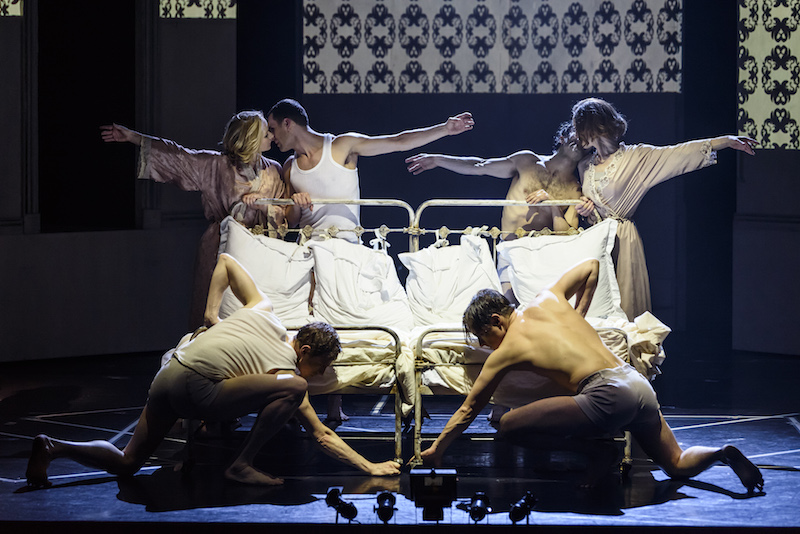
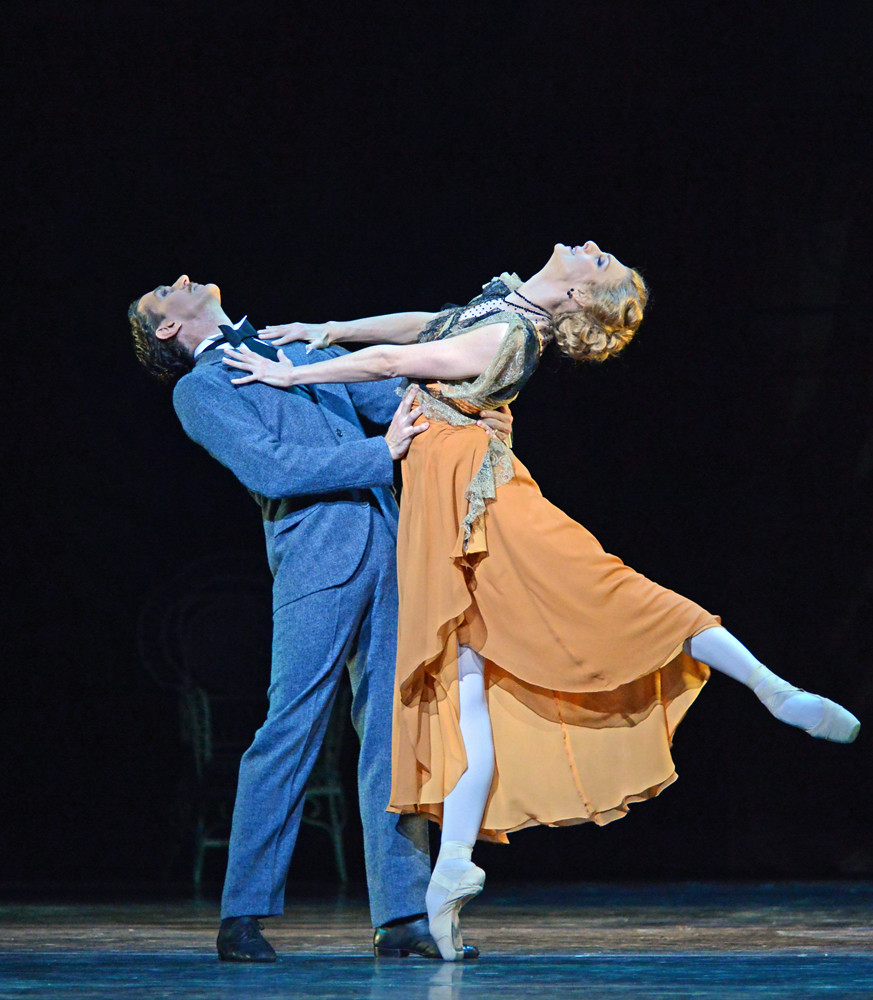
Strapless: A Failure of Narratives — Royal Opera House, 23/25 May 2017

I'm a big fan of Christopher Wheeldon's work. Which is why I'm dedicating an entire review to try and unpack why Strapless irks me so.

Strapless' Two Narratives
Strapless tells two stories — that of Sargent's repressed fantasies, and Amélie's salacious outing. The story opens on Sargent painting Pozzi, where the audience spies traces of his true sexual orientation in the tender way he positions Pozzi. Amélie enters soon after, and Pozzi is passed over to serve as her plot device, by sleeping with her and laying the groundwork for her debauchery. In the following party scene, we are introduced to Sargent's relationship with Albert, and have a fleeting development in Amélie's plot as she decides to commission a work from Sargent.

Parallel storylines for Amélie and Sargent. Source: DanceTabs
Next we come to the pivotal moment of the piece — where Sargent can only muster inspiration by imagining Albert in the place of Amélie. This presumably is what causes him to paint her strapless, his brush tinged with a lingering lust. Finally, at the piece's premiere, all goes to hell and Amélie's reputation is tarnished, while Sargent walks away unsullied. It is this contrast (I assume) that is meant to carry the emotional weight of the piece.

There are two main reasons why the narratives fall short of their emotional promise: a lack of stakes, and an absence of touchpoints between the two storylines.

Insufficient Stakes
The first error is mostly committed by Sargent's storyline — where there are never any stakes established for his potential outing. Perhaps one is to assume the backdrop that being gay was a grievous social transgression then, but the dangers of this are never made clear in the piece. Sargent flirts quite casually with both Pozzi and Albert, such that you assume his impunity from the beginning. Hence the unfolding of events in the ballet have almost no bearing for him — it becomes a terribly banal, straightforward story of Just another day in the life of John Singer Sargent.

The stakes seem clearer for Amélie, as a socialite with all her standing to lose. However, right from the get go, Wheeldon establishes her as an adulterer, indicating that she was perhaps already well on her way to becoming a pariah. The stakes of the painting itself are therefore brought lower, when her eventual outcasting appears inevitable.

Consequently, for both Amélie and Sargent, the audience is never able to truly invest in the rise to the climax and the fallout from it, as there are simply no relevant stakes at play.

Inconsequential Touchpoints
The second key way the piece suffers is that the narratives fail to effectively interweave. For two narratives to do so, they should share touchpoints that serve as a turnkey for both — such as (1) both undergoing the same initiating event but arriving at different outcomes;  or (2) both starting from different places to come to the same eventuality. Such interweaving allows two divergent stories to resonate, where the audience gains a greater appreciation for the significance of factors in one story because of the counterexample provided in the other. In the case of Strapless, the audience must ideally walk away with an understanding of what factors in Sargent's life enabled him to escape the fate of social exile that Amélie could not.

Ineffectively intertwined. Source: DanceTabs
Unfortunately, Strapless only manages a superficial tethering of the story lines — where as much as both characters appear in the same time and space, their stories fail to interweave in any way that is material to the trajectory of each.

For example, while Amélie and Sargent may begin with the same touchpoint of Pozzi, whom both use as an object of sexual desire, their interactions with him do not appear to be the reasons why Sargent's and Amélie's fates diverge, since both had illicit dalliances with him. Therefore, Pozzi serves as an effective foil to establish who the characters are, but does not serve the purpose of starting the characters on meaningfully divergent paths.

More likely, the cleaving event is meant to be the painting itself — the third scene, where Sargent substitutes Amélie with Albert for inspiration. However as much as this (supposedly) may be a pivotal moment for Sargent, where he perhaps embraces the truth and immutability of his feelings for Albert, this moment has no meaning for Amélie. She is merely a prop in this revelation for Sargent, and as such her own journey makes no progress.

I wonder if Wheeldon in fact meant this, where the weight of the story lies in how Amélie's fate was simply collateral damage in another man's selfish satisfaction. But to make this of consequence to Amélie's narrative, he has to show just how much this event matters to her — perhaps by removing her as the third wheel in the pas de trois, and elevating her half of the story with a solo, where she rejoices at the painting's completion, assuming it will only bring her greater social stature.

An Inexplicable Conclusion
Ultimately, because of these various shortcomings, the audience is never able to understand why the painting matters at all. The stakes that it is meant to be invested with are never well established, dulling the purpose of the story. Furthermore, the story is complicated by two narratives which are unable to bring each other any closer to meaning — but again, with no stakes at play, there simply is no meaning to hammer home. Consequently, Strapless really has nothing to say.

There are a couple of ways I suppose the piece might have been fixed. Certainly, the dichotomy of Sargent's and Amélie's fates... the seemingly unwarranted furore over a simple strap, etc. are fascinating raw material. If Wheeldon is still hoping to anchor the piece on why their fates diverged, he might perhaps consider the answer that Amélie's adulterous misdeeds were well known, while Sargent's were not. He might then have built the corps around them to indicate that the public was more aware of one than the other, such that the blame of the piece reflexively fell to Amélie in the end. Rather than building up Amélie's social capital (e.g. through her solo prior to the unveiling) only to artificially contrast her downfall (because the audience knows she was an adulterous pariah already), the piece might focus on how Sargent and Amélie managed the public's perceptions of them quite differently.

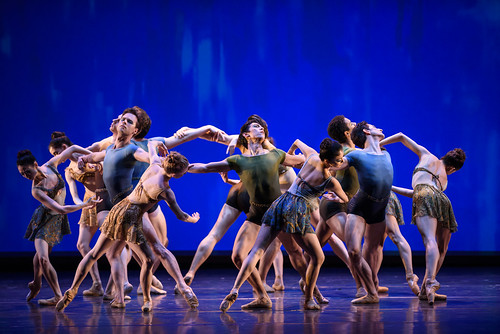
Or, they could have simply pulled a Symphonic Dances — and built moves that flow so seamlessly with the music, and are so intoxicating to the senses, that no one could bother any less about a story that begins with a bold overhaul of gender norms, only to end with surprising misogyny. (I shall get to you later, Liam Scarlett. Perhaps.)

Sunday, January 29, 2017

Layers and Permutations of Lises and Pauls -- Les Enfants Terribles, Barbican Theatre, 27-29 Jan 2017

Source - The Arts Desk, Bill Cooper

This piece confused me.

So I would have been fine if it was meant to be an eclectic pastiche of pretty sights and sounds. But with director cum choreographer Javier de Frutos intimating that each of the 4? 5? Lises and Pauls were supposed to represent different facets of this doomed sibling duo, I kept looking for deeper meaning in the clash of identities, only to constantly come up empty.

It was fairly simple at the beginning, where the different pairings of Lises and Pauls adopted much of the same characterizations, flirting innocently and then dangerously in the bathtub together. All pairs had the same costumes, the same props, the same steps, and I could deal with this nice colouring around the edges of each character, which was quite à la Matthew Bourne's Song Without Words. (de Frutos clearly has a knack for painting a scene with movement, able to deftly control the ebb and flow of motion, and accentuate subtleties in the score.)

But the moment Jennifer Davis and Gyula Nagy come on stage, singing Philip Glass' very literal libretto, they cannot help but strike an extremely different note from the dancers around them. Their threads of the storyline are transparent and pointed in a way that the dancers' motions cannot be, and so they end up drawing much of the attention. Thus as much as the publicity posters and the order of the curtain call try to tell me otherwise, Edward Watson and Zenaida Yanowsky are not the key players of this piece.

In some ways, I can see how they were designed to be so. Though Davis and Nagy are literal and obvious, they are flatter because of it. One can suppose that in contrast, Watson and Yanowsky represent the deeper and more fascinating subconscious of the characters that are both aware of and conflicted about the true danger of their game. Davis and Nagy portray childish petulance from start to finish, but Watson and Yanowsky express delicious love, malice, regret, despair, insanity. However all of this is shunned to the sidelines, obscured behind other performers, or simply done away with too quickly. Even when they are the highlight, their choreography is far too poised and statuesque to be as earthy and real as the characters they supposedly represent. So if they are indeed meant to be the richer body of the piece, this is done quite ineffectively.

Regardless, the question of who carries the meat of the storyline is moot by the end of the piece, because as time goes on each performer acquires such different movement, props, and costumes that keeping track of what the point of it all is becomes a bit hopeless. As such, my fancy flitted to the one stable character of the piece -- that is, Jean Marc Puissant's gorgeous set. It mostly comprises a fairly minimalist set of 5 sliding walls with modular steps, but onto these are projected beautiful displays that range from a whimsical sideways Eiffel tower during Paul's sleep walk, to a trypophobia-inducing collage of eyes during the children's first game. To be fair however, it does brink on over-busyness just like the rest of the piece -- where the performers are constantly shifting set pieces, picking up errant socks, or locking down a shaky wall mid-choreography. It was even the source of a full-on interruption of the performance on premiere night, where one wall piece wouldn't budge and the scene had to be repeated from the beginning.

All in all, maybe the point is to confuse. Or the point is to walk away flooded with a nice mélange of sights and sounds. But I can't help but think that with a story as poignant as Les Enfants Terribles, I should at least feel something by the end of it. And in particular, knowing what the combined dramatic prowess of Watson and Yanowsky might have done in different hands, the most coherent feeling I leave with is sadly one of disappointment.

Monday, June 13, 2016

2x3 > 6 at the Obsidian Triple, Royal Ballet, 11 June 2016

It’s not often that I’m in London long enough to enjoy two casts of the same show. So it was a delight to discover that in watching both Obsidian Triples on the Royal Ballet’s last day of the season, I got to see what felt like 6 entirely different pieces.

Image credit: Andrej Uspenski
Obsidian Tear, Wayne McGregor’s new piece, swung my opinions the most from cast to cast. In the matinee, led by Lukas Bjørneboe Brændsrød, Nicol Edmonds and Benjamin Ella, the story came across as one in which Brændsrød and Ella were lovers, torn apart by society. Their movements were complementary; their pas de deux conversational.

However in the evening’s performance, led by Matthew Ball, Calvin Richardson and Edward Watson, Ball and Richardson presented a striking similarity in physique, which suddenly implied that they were two halves of the same person – with Richardson the tender hearted core of Ball, which he eventually could not live without. Compared to the afternoon’s portrayal, their movement geometries were much more alike, and their interactions more of self-recognition than of love.

My second viewing also had the advantage of familiarity – I was able to follow more of what was happening, and soon discovered the unique characterizations of the different dancers. Some have mentioned Watson as a type of devil character encouraging Ball to abandon Richardson. However there was an interesting nuance to this, where it was Eric Underwood whom Watson first incited, in a very intimate pas de deux where he literally rubbed his influence off on the former. Underwood was then the one who marked Richardson, ultimately condemning him.

The other key revelation of the evening’s version was Calvin Richardson – an astonishing young spark who gave a remarkably honest and brave performance. He embodied McGregor’s choreography perfectly, finding its softness in a way I’ve not seen other Royal Ballet dancers able to do before, and grounding the moves in an emotional truth. I am very much looking forward to seeing him again.

Image credit: Dance Tabs
The interpretations in The Invitation were also wildly different between afternoon and evening. It surprised me how much there is to the ballet – it gets unfortunately shortchanged in summary when the description jumps to the rape scene. Ironically, it was that scene which was the least poignant for me, because of the far more engaging and intricate character developments that preceded it.

Thomas Whitehead’s Husband in the afternoon was your classic perverted sociopath – not shedding an ounce of feeling from start to finish. He only knew possessions, not emotions – and The Girl was to him like a porcelain doll to be added to his chilling basement collection. He touched her tenderly at first, careful not to damage the packaging – then finally decided To hell with it, this one I actually want to enjoy, and ripped apart the packaging like a rabid dog.

Olivia Cowley also gave a notable interpretation of the Wife in the afternoon. It could be her likeness in age and demeanour to Yasmine Naghdi, but I immediately saw The Girl buried inside her Wife. She had a strange look of recognition upon seeing her Husband’s interaction with the Girl, appearing to know from the start exactly how events would unfold. Her pas de deux with the Boy felt like a reminiscence to a time when she herself was innocent, and she was merely trying to recapture a young love that was never afforded to her. God, that hurt to watch.

Instead of reopening old wounds, the evening’s performance cut entirely new ones. Its brand of anguish was rooted in how the poison of a loveless marriage could come to destroy the innocence in its path. Gary Avis and Zenaida Yanowsky portrayed a Husband and Wife whose pursuit of an outward decorum had left all their arguments unresolved, festering into a deep mutual hatred. Their disdain for one another was apparent from the moment they entered – as Avis sauntered callously away mid-introduction, you could cut Yanowsky’s irritation with a knife. The hatred was spread thickly onto their pas de deux, as they pushed each other away as violently as propriety would allow. These two incredibly powerful dancers brought so much history and subtext to their partnership, even when standing still, that I truly felt the urge to tell them to slow down and stop yelling at each other.

The Boy and Girl then entered into this mire, and the resulting interplay was remarkably rich. Vadim Muntagirov soaked up Yanowsky’s predation with such painful innocence; and Yanowsky’s pride was palpable as she lured him in. Hayward flitted haplessly from Muntagirov’s clumsy affection to Avis’ serene gravity; and Avis became increasingly amused by her flirtations, repeatedly shaking his head subtly to both chide her and express his disbelief about his growing power over her. It was a treatment so disturbingly gratifying that despite the occasion, I began to grin widely, suddenly beside myself with admiration for this magnificent company.

With Yanowsky, Avis and Hayward in particular adding so much texture to their interpretations, there was simply too much to take in. At some point, after trying desperately to watch the Wife watching the Husband watching the Girl watching the Boy, I had to give up. What I can capture within my limits as an audience member is far smaller than what these artists give on stage; and what I can put into words, even less.

Image credit: Royal Opera House
I lie – I actually only saw 5 ballets, because Within the Golden Hour was so surprisingly soporific that I tuned out equally in the afternoon and evening performances. Both casts were stellar of course in their execution, but something just didn’t hit home with Christopher Wheeldon’s choreography. It could be the God-awful costumes, as has been commented – but for me it was largely the lack of an underlying movement theme. Nothing keeps the piece together – it is simply a series of charming, but underwhelming, vignettes.


Anyhow. Dear Royal Ballet: I will miss you sorely this summer, even more than I already miss you from living oceans away. But come hell or highwater, I will always find my way to Covent Garden.

Saturday, June 11, 2016

Fascinating New Feelings at The Winter's Tale, Royal Ballet, 10 June 2016

Image credit: DanceTabs
At about 30 odd viewings and counting, this ballet really should not surprise me. Yet it not only did; it recaptured me wholeheartedly and brought me to the edge of my seat, wringing my hands until they paled.

Back in its 2014 premiere, I was already won over -- in fact, it was that very ballet that reawakened this blog, to give words to the many emotions that were overflowing from me, out of the theatre, and onto Bow Street. But since then, The Winter's Tale has been doing some very interesting evolution -- bringing out more of the emotional complexity that I loved in the original, resulting in an interpretation that is now far more human, far richer and beautifully uncomfortable.

The thing most clear now is how flawed Leontes is. Before, he came across as simply mad, which, to be honest, was a characterization almost too vanilla for Edward Watson. His anger and jealousy were unwavering, but because of that, uninteresting. In this new run, however, these emotions slowly grow on him. Watson doesn't rise straight to a gut-clenching, arm-twisting fervour in his solo -- instead, he is visibly cautious, confused as much as he is angered by the possibility of Hermoine's infidelity running through his mind. Even as he accuses Polixenes and Hermoine, he backs off every few steps to tease that perhaps he has calmed himself and is thinking clearly once more. He keeps vacillating in the conclusion he has drawn -- such than when he finally reaches for the knife, his murderous intent feels like a clear choice, not something he was driven to in a frenzy.

Consequently, Leontes becomes highly unlikeable. Before, he was just plain mad, to an almost forgivable degree. I mean, it happens to us all the time -- something snaps, everything becomes a blurry red haze, and we emerge on the other side friendless, childless, wifeless (or something to that effect). But for him to actually have a moment where he considers the baby, stirring hopeful excitement from Paulina; or for him to stare long, hard and almost gentle at Hermoine during her plea -- well then it makes me hate him to the core when he finally condemns his wife regardless. He is weak and unkind -- his actions resulting from a shallow need to preserve his pride.

Not only do I despise Leontes, it appears none of the other characters can stand him either. No one can bring themselves to smile at him throughout the ballet. Paulina turns her head away in disgust as he walks past her during the trial; Polixenes leans reflexively to run away when their paths cross again. Mamillius too (played again by the increasingly mature Joe Parker) clearly knows which parent to sidle up to.

Even the end is discomforting in this respect because it is clearly not a redemption for Leontes. It's been 16 years already but Hermoine is still disdainful of him -- she repeats her pleading arabesques almost to test if he is still the same insecure bastard inside. It is so much to Lauren Cuthbertson's credit that this scene sits as unsatisfyingly as it does -- she is now the one to vacillate whether she will hate him or tolerate him for the sake of their daughter. Zenaida Yanowsky (of course, that magical creature) likewise imbues Paulina with that uncomfortable tension, where it is clear that at not one moment does she forgive Leontes, nor is she trying to help him through a difficult time. There is no care in her embrace or her cradling of his head -- there is only a deeply buried rage that she has turned into resignation, to do a great duty of love for Hermoine, and transform him as much as possible into a better man while she waits in hiding.

Thus tonight, I am left full of angst. And I absolutely love it.

Wednesday, January 13, 2016

Elizabeth

Every time I leave a ballet, I marvel at what it has done to me. Some do a little, the worst do almost nothing at all, but the best -- the very best -- render an undeniable transformation. I write reviews as some attempt to capture this change; it is a desperate compulsion I feel after each piece to explain what I have experienced, that I might process why it engaged me so, and perhaps even pen it in a way that someone else might engage vicariously. But in many ways there is a necessary structure to this, a manner of informative exposition that pithily captures what occurred on stage, but so poorly captures what occurred inside me.

As such, this review, I write for myself. But perhaps, it is written for you too. Here is what it feels like to watch Elizabeth.

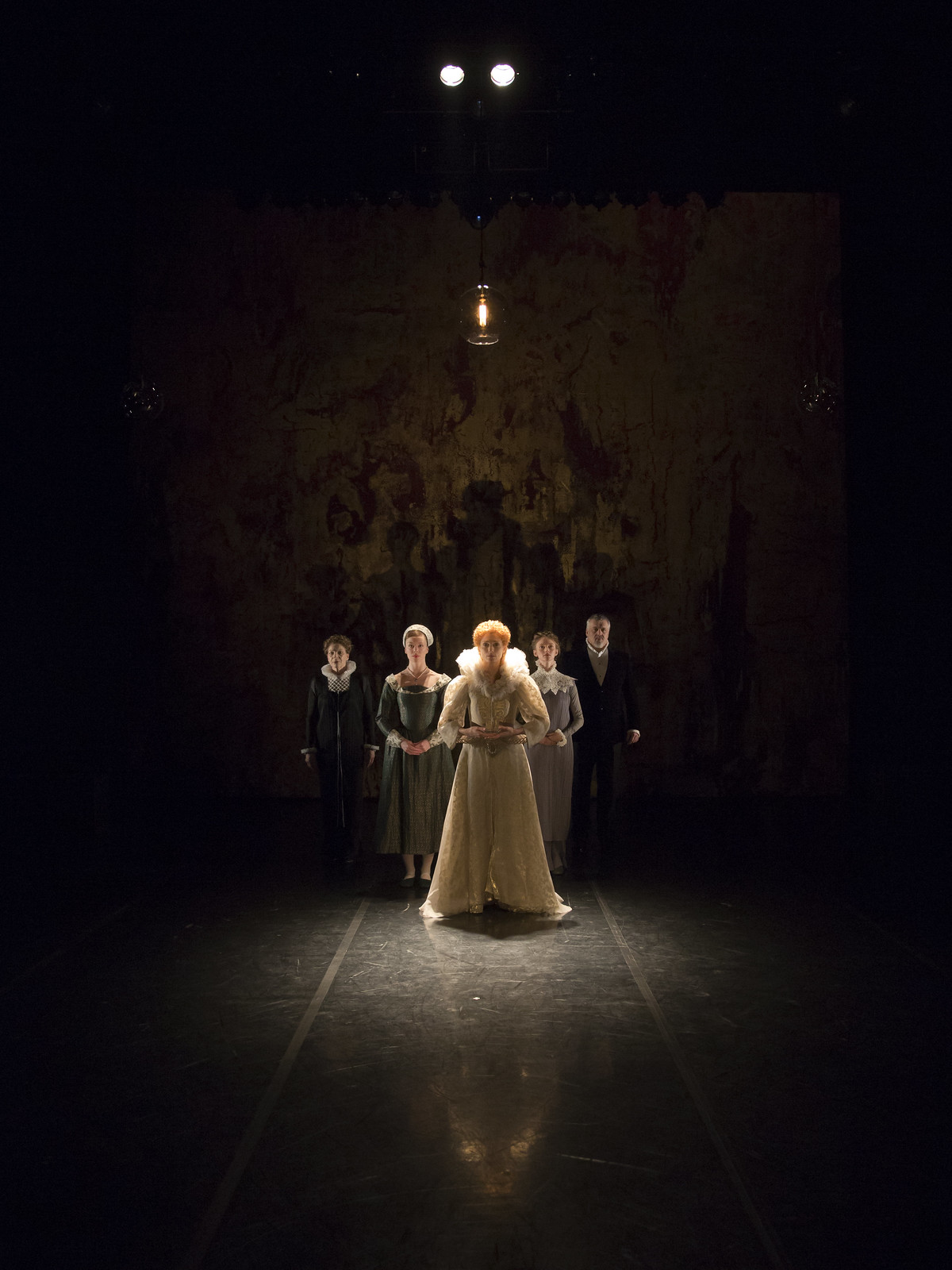
The quiet before a performance is one of my most favourite parts. Almost anything can happen. And even if you know what's supposed to happen -- who enters when and what the choreography is -- this is the point at which you surrender judgment, logic, thought, experience. In the social contract of the theatre, you give yourself to the performers, and enter the unknown. Raphael Wallfisch takes his place in the darkness on stage right, and Zenaida Yanowsky, Sonya Cullingford, Laura Caldow, Julia Righton and David Kempster arrive at their opening positions centerstage. Then, just before the first word is spoken, the first note struck or the first movement made -- in Wallfisch's poised bow and Yanowsky's parting hands -- I see a glimpse of where they will take me and the thrill of it is nearly giddying.

The story quickly unfolds, and I take in everything that Will Tuckett is saying to me. The language is foreign and fast but I grow to decipher it. I learn to toggle my attention between dancer and actor; I learn to connect them with the ticks he has given both, where Cullingford and Yanowsky wring their hands in the same way; I learn his syncopation of the movement between Yanowsky and Carlos Acosta, where in solos and even in pas de deux, they always mirror or wait on the other's move -- discovering this means that Elizabeth and her lovers are always out of phase.

I learn it sooner than I realize, suddenly able to translate his movement into not only thought, but feeling. I'm grinning the way Yanowsky is as she coyly references her bedroom affairs, or frowning the way Acosta is as his proposal is rebutted. My whole body tenses as Yanowsky watches the she-wolf Lettice Knollys, relaxes as she finds a nook in Acosta's neck to rest in, then soars as he lifts her in a pas de chat across the stage. My body has found an empathy with the movement -- and with that comes a power which is no longer in the hands of the choreographer or performers. Empathy is the point at which the audience takes over to multiply every emotion seen on stage by a hundredfold, with the joy and pain we have had in our own lives.

It is the authenticity of the performer that can bring the audience here -- one who is selfless enough in their performance to give everything to a character, and in so doing, give it away. Some dancers take the journey alone, creating a vision that the audience can find beautiful and admirable, but cannot live. But that is not the case with these performers, and especially, especially, not with Yanowsky. They bring the entirety and gravity of the characters' intentions into every part of their body as they move. Merely a glimpse in their direction and I cannot tear away, caught in the wellspring of emotion they have triggered.

And just when I am most deeply in their hold, Tuckett brings the piece around full circle. This point exists in almost every piece -- a special juncture at which it turns around and reflects upon itself, ready to unravel its true meaning and bring the weight of its message down upon the audience. As Acosta and Yanowsky dance their last two pas de deux, they replay much of the same movements from their scenes before. Elizabeth tries to revive Devereux's limp body to hold her the way others had; Acosta kisses a dying Elizabeth's hand as Dudley did, bringing a final rejuvenation that gives her the peace to let go. The symmetry of these scenes are their source of amplification, echoing the depths of what Elizabeth has lost and learnt to live with. There is far too much to speak about in these final moments of the ballet, as the volume of emotion I have built up through its course collapses in on itself.

The time here is both incredibly cacophonous and incredibly quiet. In the intensity of the emotion I find a space I rarely have the chance to visit. Not in the daily goings on that move too fast for emotions to be had let alone understood, nor even in the times of reflection where trying to understand an emotion somehow distorts it. Here, in the darkness of the audience and the light of the stage, I feel like someone has shaken me by the shoulders and told me who I am. I feel like I have been asked many deep and piercing questions that I haven't had the time to process, and I have answered as viscerally as I can through emotions I did not know I possessed. I feel like my mind has connected to my heart through a path I never knew existed, sending a shock through the rest of my body. I feel I've been helped to finish a sentence I never thought I had to say.

And then the moment ends, the lights raise, and the magic is broken. Yet it is somehow even more magical to realize it was made by the human hands that take their curtain call in front of you. I am exhausted, content, exuberant, refreshed, and I leave the theatre somehow more certain of who I am.


Sunday, January 10, 2016

Elizabeth, Will Tuckett, Linbury Studio Theatre, 8/9 Jan 2016

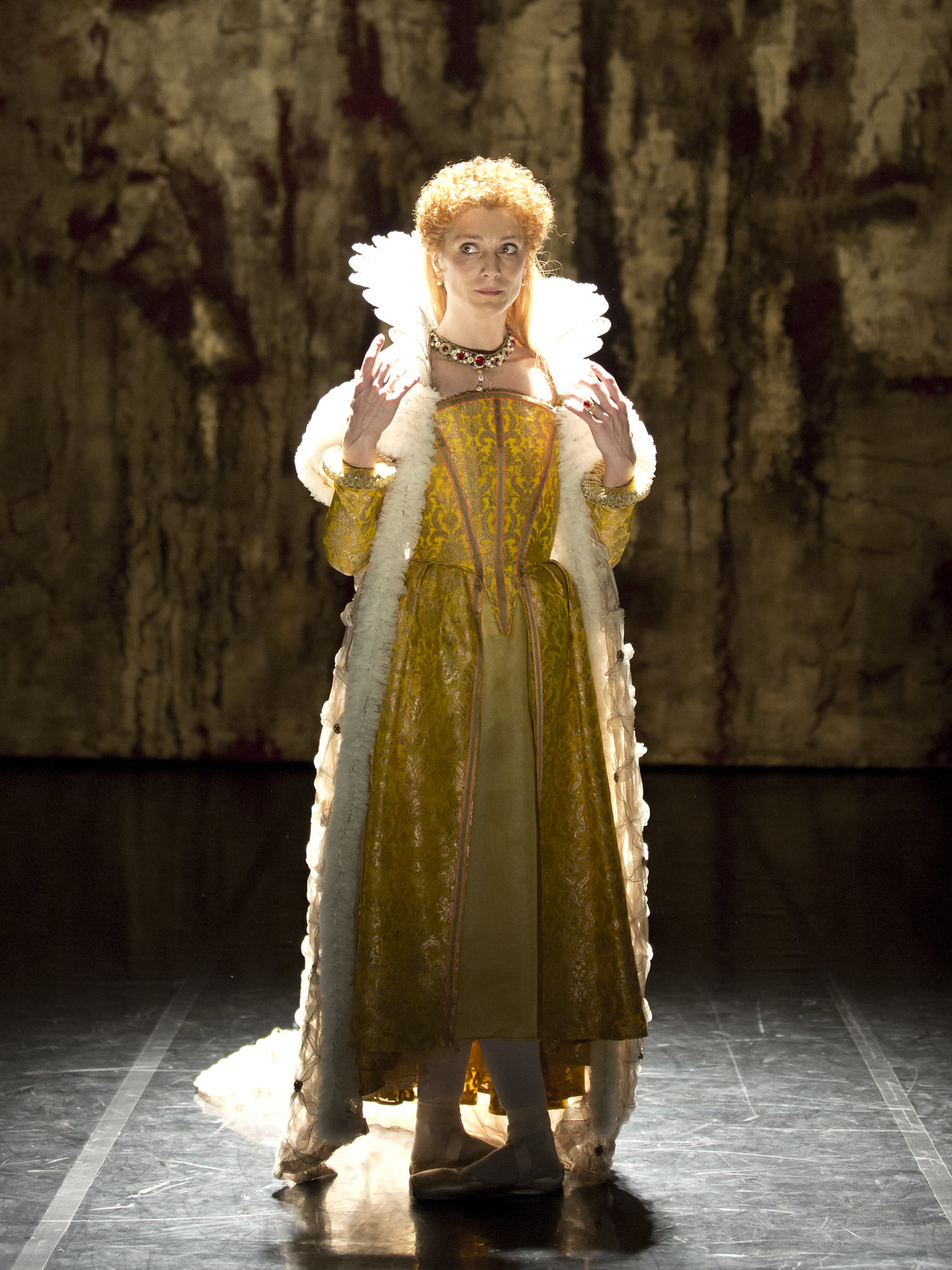
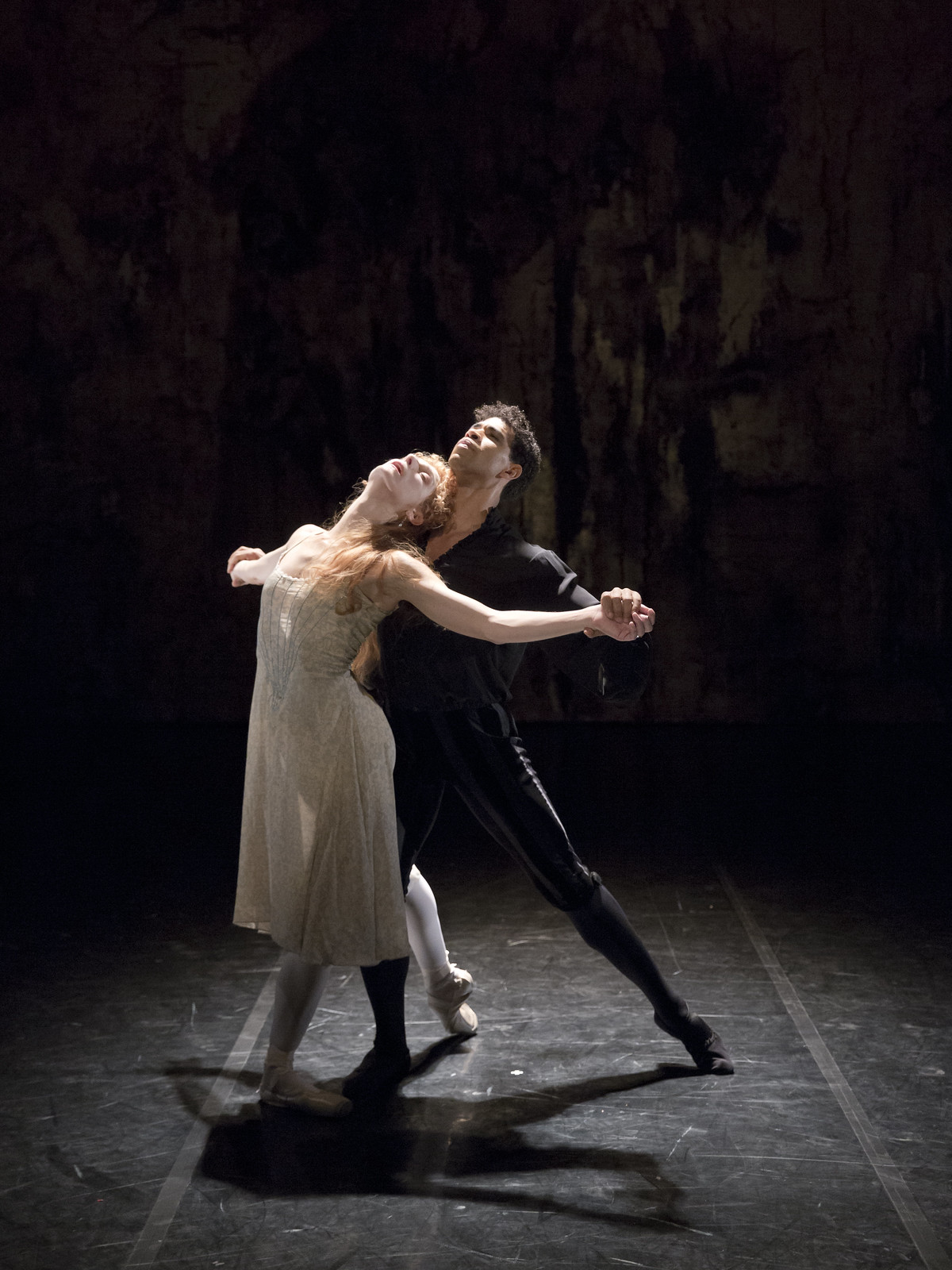
Zenaida Yanowsky in Will Tuckett's Elizabeth © ROH, 2016. Photographed by Andrej Uspenski
This winter, the dark and austere Linbury Studio Theatre is an unlikely window into a beautifully painted picture of the life of Queen Elizabeth. With a small but powerful team, Will Tuckett brings Elizabeth to life through a stunning trifecta of movement, music and text. 

Zenaida Yanowsky fills the room with Elizabeth's regality from the moment the piece begins, pacing hastily onstage with her posse in tow. In her posture, expression and intricate regalia, she is an immediate queen. Yet this is swiftly undone as we dive straight into Elizabeth's last days. Laura Caldow, Sonya Cullingford and Julia Righton provide a powerful narration of Elizabeth's failing health and final lamentations of loves lost, which Yanowsky visualizes with desperate reaches, empty gazes and aching backbends. The portrait of a proud but exhausted and lovelorn queen emerges, as Tuckett lays the foundation to tell her story through the relationships that have tried her so. 

Scene by scene, we are taken through each affair -- from Robert Dudley, Earl of Leicester, to Duc D'Anjou of France, to Sir Walter Raleigh, to Robert Devereux, Earl of Essex. Carlos Acosta dances all of these in turn, instinctively infusing every character with a unique presence and style of movement. Dudley is warm and gentle towards Elizabeth, D'Anjou is foolish, Raleigh is pompous and Devereux severe. Acosta transitions effortlessly through this gamut of personalities, and whether he is curving his body with a shy and sheepish grin, or beating his chest with a rallying cry for rebellion, he is a consummate entertainer.

Zenaida Yanowsky and Carlos Acosta in Will Tuckett's Elizabeth © ROH, 2016. Photographed by Andrej Uspenski
Each of these men captures and breaks Elizabeth's heart in increasingly deeper ways. It is ever captivating to watch Yanowsky as she transforms Elizabeth through each transgression. At first she is young and love is trivial, shrugging off the notion of marriage and letting Dudley's betrayal slide off her back. She is above love -- wedded to her kingdom, as Cullingford narrates so, and Yanowsky casts an imposing silhouette caressing her coronation ring. But she soon succumbs deeply to love upon meeting D'anjou, whose charming and ingenue ways soften her heart, only to cripple it when he dies in battle. A beautiful change in the architecture of the piece happens here -- the older Righton takes over from Cullingford as Elizabeth's voice, the choreography loses all of its cheekiness, and Yanowsky becomes cold, serene and hardened. Elizabeth ages greatly with this loss.

Then, despite initial skepticism, she lets her guard down and welcomes Walter Raleigh into her life, who turns and betrays her through affairs yet again. And finally Devereux betrayes her through rebellion, forcing her to order his execution. This final loss fills her with regret, which we see embodied in a stunning pas de deux between Yanowsky and Acosta. Elizabeth revives Devereux's body, hoping wistfully to have compromised that she might have enjoyed love. Yanowsky's dancing is beautifully and painfully contradictory, filled with anger at both Devereux and herself, as she leans into Acosta then furiously pushes away. She ends with desperate kisses onto his body, only to have him die once more. The piece then bookends with the repetition of Elizabeth's own death scene.

The whole affair is a complete symphony for the senses. The actors narrate almost every move, such that the audience both sees and hears directly of D'anjou's innocence as Acosta leaps jovially, or is provided the voiceover for Elizabeth's thoughts as she rages at Raleigh's betrayal. Oftentimes it is extremely direct, with both actor and dancer standing side by side, delivering dialogue through both word and gesture. There is even the occasional interaction between actors and dancers, where Acosta and Yanowsky respond defiantly to information from the actors that both Dudley and Raleigh are married. Through this all, the music provides yet another level of narration, where the masterful Raphael Wallfisch on the cello raises the tension, or baritone David Kempster eases with his voice.

Zenaida Yanowsky and members of The Royal Ballet in Will Tuckett's Elizabeth © ROH, 2016. Photographed by Andrej Uspenski
Yet because of how complete it is, it is also lacking. Almost every thought and emotion is told to the audience, such that there is little left to infer, and because of that, little room through which one can dive deeper into the piece and have it engage deeply with one's soul. Dance, in particular, is something that typically leaves a huge space between then performer and the audience -- and the entire art form is then about the interpretation that is built therein. Even the performers themselves seem somewhat stunted, robbed of the ability to interpret a story in their own way, now that they are given a play by play of which expression to deliver. The most engaging were the pas de deux -- protected islands of just music and movement, that were prefaced by a concept in the text, but then richly interpreted in infinitely more dimensions through Acosta's and Yanowsky's powerful pairing.

Most of all, though appealing to the senses, there is no overwhelming reason in the piece to separate the dancers and actors so. If one was Elizabeth's inner voice and the other her outward personality, it may have made sense; if one the voice of reason and the other the voice of passion, that would have worked as well. Yet the decision of when to speak or dance each phrase seemed driven sadly arbitrarily, or worse, by whenever a water break or costume change was required.

As such, the piece is a beautiful one, but one that lives only in the space of 90 minutes, and leaves me quickly thereafter -- a hopeless contrast to my last visit to Covent Garden, which a year later, still resonates more strongly then the piece I left last night.


Friday, January 8, 2016

The Nutcracker, New York City Ballet, Lincoln Center, 29 Dec 2015

You can tell the quality of a Nutcracker by its snowblowers. In the Lincoln Center, snow doesn't just fall straight down from the rafters -- instead, it is blown gently by fans in the wings, that mix the snowfall into a beautiful flurry. As the corp de ballet posé pirouette and coupé jeté en tournant, so do the bits of snow spin in turbulence. A thick sheet eventually covers the whole stage, capturing Marie and her prince's footprints as they journey toward the land of sweets.

It's perhaps an odd and superficial way to judge a ballet, yet this level of care and detail is entirely telling of the New York City Ballet's magical production of the Nutcracker. In everything from the staging, to the acting, to the dancing, it is clear that no stone has been left unturned. While I usually can't wait for the festivities of Act I to be done with, I found myself unexpectedly enraptured in the childrens' interactions. Every child had such different ways of teasing one another and reacting with their parents. Some were naughty, some were shy, and you could even see a mini-story unfold as children learnt their lessons over the course of the party. Come the battle between rank and rodent, I was again delightfully entertained. Groups of each broke off into complex tactics, leaping over and pouncing at one another, to the point that I actually began to fret for the Nutcracker prince.

Once the snowflakes came on stage, the richness of acting gave way to a richness of choreography. Balanchine's gift of visualizing music brings Tchaikovsky's grand score to life, lending a unique emotional quality of mystique and treachery that a winter journey for a small child dressed in a nightgown really should have. As the key changed from minor to major, so did the corps' movements change from frantic to languid. It is stunning choreography that had me at the edge of my seat, straining my eyes to soak in as much of it as possible.

With its short vignettes and lack of a story, Act II didn't have as much of a chance to set itself apart from other Nutcrackers. The Spanish had flair; the Chinese were sharp and cheerful; Mother Ginger was as horrifying as the day I ran out from under her skirt many lifetimes ago. There were some unique touches however, the most charming of which being the addition of a small flock of confused sheep to the Mirlitons; and the most mind-bending of which being the Sugar Plum Fairy's slide across the stage in an arabesque on pointe. My jaw literally dropped as Gonzalo Garcia, holding Tiler Peck steady in an arabesque, began to drag her slowly across the stage. Her arabesque remained completely steady as her whole body was displaced. It is difficult to describe because it is simply beyond ballet's vocabulary.

With its debut in 1954, this production of the Nutcracker is said to have sparked off the worldwide trend of staging it as a Christmas tradition, and it is not difficult to see why. Joy flows off the stage with every leap and bound, filling the audience with the spirit of the season.

Thursday, June 4, 2015

Swan Lake, St Petersburg Ballet, Marina Bay Sands Theatre, 1 Jun 2015

Photo from: http://durban.getitonline.co.za/2014/10/06/st-petersburg-ballet-theatre-returns-south-africa-next-year/

I began to brace myself the moment the curtain rose, revealing four pairs of jarringly unpointed feet in petit allegro. I had heard little about St Petersburg Ballet before this, knowing only that they were a uniquely independent Russian company, that their production of Swan Lake had been selling out in Paris and London, and that here too in Singapore I was watching one of two shows they added last minute after the first five had sold out. 

But as the festivities of Act 1 unfolded, and the corps continued to dance and socialise as if all the alcohol just ran out, I sank deeper into my seat, disappointed. Siegfried, too, danced by Dmitriy Akulinin, emerged soon after as a lacklustre prince, competent but not compelling in his execution. It seemed that the company was surviving on hype, and the ever-reliable sales formula of Swan Lake. The strange choice of the Sands Theatre as well, with its popcorn that went decently with musicals and rock concerts, but most questionably with a white swan pas de deux, made the whole affair gimmicky.

Act 1 did lend some saving graces however -- while the company's men left much to be desired (searing in the memory of piqués as gentle as pile drivers), the ladies showed off sure technique and beautiful arabesques. Another standout for me was Andrei Fedorkov as the Jester, who bounded on stage at just the right time to revive the quickly waning energy. His leaps were clean and impressive and his whims charming, and I breathed a sigh of relief. But they were too few and far between -- tired from a long day, I took the shocking liberty of a nap.

But from this torpor I was jerked awake by Irina Kolesnikova. She presented nothing short of a vision as she made her entrance, arms sweeping mystifying arcs through space and filling the music to its brim. I fell deeply and immediately in love with the rippling of her movements, where every motion literally started from the centre of her being and unfolded towards her extremities -- conjuring imagery of the gentle crashing of waves upon a shore. She was powerful yet gentle, in turn tearing majestically away from Siegfried, or brushing a port de bras tenderly across his face. For all the hours I’ve spent in Odette’s thrall, watching interpretation after interpretation of the same motions ad nauseum, I was not expecting to be so taken aback by the unique grace and grandeur of her Swan Queen.

Irina Kolesnikova, photo by Konstantin Tachkin
Her Odette was so entrancing that at the close of Act 2, I thought her Odile would surely fail to impress by comparison, but I was gladly proven wrong. Rather than being a simple puppet of Rothbart’s, her Odile took charge of and took much delight in the trickery herself -- displaying obnoxious relish as she mimicked Odette's dainty poses or egged Siegfried on. She mirrored Odette’s touch to Siegfried’s face, but this time moved in disarmingly close with a withering stare, as if musing “I wonder which part of you I shall devour first”. Her vigorous movement was also the antithesis to Odette’s languid manner – with crisp jumps and brisk fouettés proof of the range of technical excellence at her disposal. Many a double pirouette decelerated like fine machinery into a slow and controlled third that made my jaw drop to the floor.

It was these feats and delicate interpretations that almost, but unsuccessfully, masked the absence of a soul in the production – not only in the overall cast, but less noticeably, in Kolesnikova as well. While her movements might have come physically from the heart, they did not emotionally. It was as if she had written a very convincing script with her body, exquisitely designing where each part of it should go, but was miles away as she read it. There was the flinch of panic but not panic itself, the yearning neck of sadness but not sadness itself. The lack of a live orchestra for this traveling production also mean she has likely been perfecting her routine to the same music for quite some time now, which is perhaps why she is so comfortable within the timing but sadly, perhaps also a little jaded. The perfection she yields is almost mechanistic, and it is regrettably the absent sincerity that allows me to walk away from this love affair.

Furthermore, with the removal of all mime, there was no immersive backstory along the lines of “over there is a lake of my mother’s tears”, and an alternative libretto was used (ETA: a popular one in Russia, it seems) such that Siegfried prosaically saves the day by tearing off one of Rothbart’s wings and beating him with the bejeweled thing. Rothbart’s illusion of evil was already tenuous enough, from having been dressed up in a unitard and bedecked with rubies and galea-esque plume, coming across far less fearsome than flamboyantly fabulous. The kids behind me roared with laughter, and I too struggled to contain it.

On that note, I left the theatre feeling uncharacteristically tickled, mostly unmoved, but on the whole, still profoundly grateful for the chance to have witnessed Kolesnikova’s exquisite interpretation. With St Petersburg’s small repertoire I can’t imagine she’s been stretched much, and hope for the chance to see her wield her talents in quite different ways in the future.

Sunday, May 17, 2015

Le Corsaire, English National Ballet, Esplanade Theatre, 15 & 16 May 2015

photo by ASH, from ENB
A whirlwind tale, a desperate romance, bellicose battles and heady harems -- consider me properly swashbuckled by the English National Ballet's triumphant return to Singapore after 46 long years. What kept the company away I don't know, but I hope the cheers and shouts at everything from the simple perfection of crisp double pirouettes, to gravity-defying pas de chats en tournant, will bring them back as quickly as possible. I am not done adventuring with this merry band of buccaneers.

Le Corsaire is a terrific potpurri of sights and sounds. No less than 3 choreographers and 10 composers are credited in the programme as having added to this work since its inception in 1856, as it fell in and out of favour over time, finally arriving in fine form as Tamara Rojo's first full length commission at the ENB in 2013. The story darts this way and that, following the intrepid Conrad as his love Medora is captured, rescued, then captured again, and rescued some more, in time for them to anticlimactically sink together beneath the seas.

Each plot twist allows for refreshingly unique choreography, with the pirates clashing swords to their temps levés, or the dreamscape of Pasha's wives bourréing with their flower garlands -- all set against the rich colours and textures of Bob Ringwood's full bodied backdrops. Where the mix of creative wellsprings could have perhaps led to chaos, the result is instead harmonious, with showy choreographic moments complementing more sensitive ones, and measured use of cymbals and clarinets. Perhaps one unifying aid is a generous helping of allegro throughout the piece, stringing everything together with a buoyant consistency.

I would say most of this harmony however, comes down to how ENB has assembled Corsaire with impressive care. With their interpretation of a light-hearted bumbling Pasha, a cheeky Medora who swipes his staff away, and a useless Conrad who sniffs a poisoned rose not once but twice, one is not lost in the veering story as you feel these are simply the kind of antics these silly pirate types get up to everyday. And with Rojo's request for "a full period production as though it was staged in the 1850s with illusionistic painted scenery", the piece is firmly grounded in a traditional setting that gives it a strong overarching voice. ENB Orchestra's Music Librarian Lars Payne also put much care into reconstructing the original score, and it is in such dedicated touches of authenticity that Corsaire never loses its centre of gravity.

Photo by Dave Morgan for DanceTabs
If ENB proves itself true to form in its productions, so it does as well with its dancing. Every company would appear to have its own signature -- from what I have seen, the Royal's is its dramaticism, the Paris Opera Ballet its immaculate corps, and now for the ENB, it is an incredible control in their technique. Every single dancer on stage has this in spades, executing perfect pirouettes, holding eternal balances, adding just the right resistance to each adagio, and closing surely and neatly on every single jump -- a degree of core strength I suppose I could have surmised from the costumes' terrific display of abs. I couldn't help but put on my new found ballet-engineering hat and note that there's also a very unique flavour to their movement, in the form of a distinct deceleration then acceleration at the end of every motion, as if each pose came with a triumphant exclamation point.

And at the pinnacle of this technical excellence is of course Tamara Rojo, whom I gladly saw not once but twice due to Alina Cojocaru withdrawing for personal reasons. Her reputation precedes her, so there is really nothing more to add other than that I was checking for strings attached to the rafters in the roses she held during her preternatural Act 3 balances, and that I audibly exclaimed "What." after her endless sequence of double and triple fouettés. Not that I could be heard, amongst all the other astounded audience members around me. Just as Medora teased Pasha, so was Rojo teasing Gavin Sutherland's (very excellent) orchestration in her Act 2 solo, in a game of chicken almost, as to who would restart the music or end the balance first. The only short hiatus in my engagement was unfortunately the Act 2 pas de deux, which looked so MacMillan in its choreography, but rendered sadly none of its emotions. Fortunately the weight of the piece wasn't pinned on any real emotional depth, or this would have been the kicker for me.

Despite Rojo's talent and presence, Isaac Hernández, Cesar Corrales, Yonah Acosta and Fernando Bufalá still nearly managed to steal the show each night. The height of Acosta's pas de chats as Ali was unrivaled, and the number and variation of Corrales' and Hernández tours and battus en l'air were beyond my balletic vocabulary to describe, from my never having seen such a spectacle before. Corrales as Ali on the 16th night was almost giddy with delight in challenging himself to do 10 (or was it 11, or more?) pirouettes, and Bufalá was also not to be outshone as Birbanto on the 15th, spinning like a top with such cool confidence. Corsaire is very much a stunt piece for the men, but Shiori Kase was also remarkable as Gulnare on the 16th, moving easily from quick and sharp allegro to smooth and steady pirouettes -- yet another example of astounding ENB control.

Rarely does a piece so lift my spirits with the incredible and pure joy of dance. I'll never give up the Royal because of its dramatic bite, but with all the superlatives I just peppered into this review, I daresay ENB has offered up some strong competition for my next visit to the UK.

Friday, February 20, 2015

The Sleeping Beauty, Tokyo Ballet, Tokyo Bunka Kaikan, 7 Feb 2015

Dan Tsukamoto and Mizuka Ueno, photo by Shinji Hosono
A recent getaway to Japan meant I got to catch the Tokyo Ballet performing this classic -- supplementing an Eastern flavour in my ballet diet that's been sadly missing. This production was staged by Valdimir Malakhov (who also danced Carabosse), with Mizuka Ueno as Aurora and Dan Tsukamoto as Prince Desire.

This review is a light one, mostly because I somehow remained helplessly disengaged throughout the piece. Usually when I've watched a performance, words come pouring out, tumbling over each other in a race to describe the emotions I've just felt and spectacle I've seen. Reviews like The Chorus write themselves in the space between ordering and getting my food; ones like Cassandra, while sitting on a cold bench in Covent Garden waiting for Manon to start. But other times -- as with this production -- the piece is merely... passable, and offers no easy way for my soul or psyche to enter.

It's perhaps because I've seen Sleeping Beauty too many times, and there was nothing remarkably new about this production (except for a shockingly pink colour palette). I must also learn to stay away from a ballet I find to be terribly lacking in the dramaticism I usually crave, has a storyline I find completely inane, and that appears to benefit little from varying interpretations. (Perhaps I should also stop watching ballets within 12 hours of getting off a plane.)

Regarding the dancing, Mizuka Ueno was technically excellent, but she has a style of attack and sharpness in her movements which I somehow felt were unsuited to Aurora, whether in birthday, dream, or wedding mode. I'm probably reading far too much into it but it made Aurora come across very petulant, to the point that I was satisfied when she was pricked and put to sleep. All in all she was great, but simply not my cup of tea in this production.

Dan Tsukamoto as Prince Desire (/Florimund) was also technically proficient, but I found his performance to be underwhelming. He was stable, had height, confident partnering, but I suppose I've come to expect a certain level of showmanship. The jumps in his solos were clean entrelacés, without the multiple battus often squeezed out of the Prince's short time in the limelight. Even Ueno had the same no-nonsense approach to Aurora's famous balances -- cleanly, but very quickly, transitioning from one suitor's hand to another, with no long grand breath-suspending hold in between, even though it was clear she could have managed it.

The only one who really caught my attention was Malakhov himself as Carabosse (whom I didn't recognize until reading the programme after, as the star of my much-loved and worn DVD of Mauro Bigonzetti's Caravaggio.) His gestures were evil, alluring, interesting, reaching the distance to my 2nd level seat which none of the other dancers had been able to traverse. Interestingly, I found his curse scene to be almost a second-to-second and sentiment-to-sentiment match to Monica Mason's.

As for the rest of the cast, none were too outstanding, especially with the more than occasional premature falling-off-pointe during a pirouette, to the point that my friend expressed "concern for their safety". We found Bluebird and Florine to be standout however, both having a breathtaking lightness and fluidity, but sadly I couldn't decipher who they were from the Japanese programme.

In conclusion -- that's it, no more Sleeping Beauty for me.

Friday, December 12, 2014

Don Quixote, Singapore Dance Theatre, Esplanade, 6 Dec 2014

The Singapore Dance Theatre premiered Petipa's Don Quixote last weekend (between them and the Royal Ballet, this is an oddly fashionable Christmas choice this year!), adding their first new full length ballet in seven years. It was staged by ex Royal Ballet Principal Cynthia Harvey (whose dancing I've become quite fascinated with after a few short clips on Youtube), and Saturday's first cast had Rosa Park as Kitri, and Chen Peng as Basilio (pictured).

Funnily enough, this is only the second time I've seen the Singapore Dance Theatre in 9 years, despite it being the sole classical ballet company in Singapore. (In fact, the last full length ballet of theirs I saw was one I was actually in...!) The company changed quite drastically in the time that I was living overseas -- seeing a new artistic director, a new generation of dancers, and a renewed focus on local modern choreography. Lacking the familiar taste of the company which I in many ways grew up with, I came back and satiated my dance appetite with younger companies instead, but am now finding my way back to this old friend.

Unfortunately, I found the reunion sadly underwhelming. I'd never seen or read Don Quixote before, and suspect that a lot of the confusion I felt came rather from the inanity that is Don Q rather than the staging, which is a shame. The ballet appears to run two parallel narratives -- that of Don Q and his intrepid imagined adventures, and the simple story of village love between Kitri and Basilio. The piece tries hard to connect these disparate elements from the beginning by having a prologue scene where Kitri and Basilio somehow find their way into Don Q's sitting room, while pursuing Sancho Panza who is pursuing a chicken. Though the programme booklet took pains to spell this out, I simply could not understand what was happening on stage at all. The other attempt at intertwining the storylines, where Don Q takes Kitri to be Dulcinea, is equally incomprehensible.

I suppose all these are concerns I really should take up with Petipa. However given that they must make do with this odd backbone of a storyline, I feel like any company bold enough to tackle it must be adept enough to relay the story's subtleties, so as to prevent the whole piece from devolving into a random assemblage of variations. The dancers themselves must make the story and its undercurrent of humour come to life, but SDT unfortunately fell quite flat in this respect. Much of the corps looks nervous and self conscious on stage, and of the leads only Park and Akira Nakahama as Cupid seem to possess the requisite dynamism and lightheartedness of the piece, but it's not enough to carry the rest of the cast with them.

The company only really began to shine through in Act 2's dream, when all the theatricality had been stripped away. Much as I remember it to be, this is a beautiful and poised company, in that they specialise in the more pristine aspects of classicism. Saccharine sweet flower waltzes, doleful swans and willies, tend (or at least tended) to be much more their thing. The dryads therefore proved much more familiar and enchanting territory. Then in the tavern, the awkward characterisations and waning energy of the corps return, but it is thankfully saved by Park and Chen executing a tickling faked death.

Act 3 is then also rescued by Park and Chen's excellent wedding pas de deux. Both are technically on point but sadly the same cannot be said for most of the rest of the cast. Throughout the piece there were common trips and misplaced landings, and many even looked disinterested to be there. One of the few who actually possessed visible stage presence was the background but distinctively noticeable Stefaan Morrow, an apprentice with the company whom I look forward to seeing more of in future productions. Singapore's talented dancers have sadly been a rare breed, but this tide is hopefully about to turn, following the new options made available in arts educations and arts careers several years ago. The first wave of that initiative should be graduating now, and it will be very interesting to see the careers they pursue.

On the whole, I was perhaps too demanding of my evening and couldn't stomach Petipa's classical abstractions, especially after diving straight into it from MacMillan's realisms. All the same I do think it's a good idea for the company to keep its focus on modern choreographies, and wait for a stronger crop of dance actors before attempting the more intricate full length ballets in the future.

Tuesday, November 4, 2014

Manon, Zenaida Yanowsky & Roberto Bolle, Royal Opera House, 1 Nov 2014

1 November 2014 was truly a night to remember at the Royal Opera House. Ballets like this don't come around very often, and the cheering, stamping, standing audience at the end of the night knew it well. It was a night so amazing that it feels almost vulgar to pin it down to words and dare write about it, yet it must be preserved for posterity somehow.

Zenaida Yanowsky and Roberto Bolle gave a performance that was beyond description. They wove a love between Manon and Des Grieux that was so earnest, intricate and captivating, keeping the audience breathless for every second they were on stage together. From the moment they locked eyes in Scene 1, they fell convincingly deeper and deeper in love with every step they took together. Where there might have been doubt about Wednesday's love, here their repeated stolen glances, nervous joy when finally they met, and triumphantly exuberant first pas de deux, all made their passion abundantly clear.

In fact not only were Manon and Des Grieux falling in love, but so it seemed Yanowksy and Bolle were as well. One could see their thrill exuding with every perfectly spun pirouette, and their confidence growing with every breathtaking lift and throw. They upped the ante with each verse of the music, giving more of themselves to each other. As Yanowsky leans into him more daringly at the end of each arabesque, or pushes more fervently off his hand for a spin, Bolle meets her touch eagerly, powerfully launching her off again then catching her with an ever dependable stability. As much as they are in perfect physical synchronization, accelerating and decelerating together through the nuances of the Massanet score, so are they emotionally, gasping and almost laughing as they play with each other, casting gazes that look longingly as if into each other's souls.

Such magic can only be created by two principals clearly at their prime. Sure enough in their impeccable technique years ago, every extra moment on stage has evidently gone towards building a formidable library of expression that they both wield profoundly. For Yanowsky, I know her prowess well, yet she gave a performance this night that was more real and textured than I've ever seen. Markedly more confident at the start than she was on Wednesday, she fires out of that carriage with a gust of innocent enthusiasm, that's nestled in many subtle glances of familiar joy with her brother or gentle eye rolling at his machinations. Then towards Des Grieux's love through the night, her world visibly stops the first time she sees him; she reverses the partnering in the bedroom pas de deux with such playful invitation; her body softens as she gives in to his anguished solo in Act 2. What was a rare and special treat as well was to see how differently she handled subtleties in this performance versus the last, showing how she is not only inventive but responsive as a dance actor.

For Bolle, my first viewing of him on stage was treated to a remarkably sensitive theatricality. He is less bold in his expressions than Yanowsky but that is by no means ineffective here. He is a shy and beguilingly earnest Des Grieux, whose gentle pirouette into a kneel at the end of his Act 1 solo was so endearing that I perhaps fell deeper in love with him than Manon did. And I was astounded by the way he handled his righteous morality in Act 2, where he perfectly balances his incredulousness at Manon's susceptibility to materiality, his desperate desire to have her see the light, and his anguished sorrow for failing to treat her with anything but tender care. Thus in their combined maturity and thoughtfulness, that interacted so as to be more than the sum of its parts, the audience had no choice but to fall into their world, and both cherish then suffer together in their torturous emotional journey.

The rest of the stellar cast seals the deal. Laura Morera turns what could have easily been a token foil into a character with deep complexity, and it's a shame that much of this is seen best at the fringes of the stage. She is resilient despite Lescaut's callous treatment, and dedicated in her cautioning Manon against her dangerous materialistic descent. Carlos Acosta is delightful again as Lescaut, perhaps even more on point with the comedic timing, and more calculating in his dealings with Monsieur GM than the last night. And to his credit, Will Tuckett is downright repulsive as GM. One somewhat bone-chilling moment is when in the Act 2 pas de trois, Manon's skirt falls accidentally over his face. Once he finds his way out of it, he has an unexpectedly frightening look of satisfaction. Finally, Gary Avis is perhaps more ruthless as Gaoler, and paired with Yanowsky's all too realistic acting, I believe my heart actually stopped beating then. The energy was as infectious to the audience as to the entire cast, with every slight display of dancing or acting rich and provocative. I lament with other viewers that there was simply too much to see in this ballet!

As the evening wends its way to the final swamp pas de deux, the magic is unassailable. Here Yanowsky and Bolle cap the performance of a lifetime, hurtling themselves at each other in yet another profound showing of technical and emotional excellence. She limps about the stage then sets her eyes on him, is renewed with vitality, and runs full tilt for the clean perfection of one, two, three spins, to be brought lovingly back down by him. He pushes her head up carefully with his shoulder, then finds her dead with a pang of shock that reverberates through the auditorium, and he clutches her visibly mouthing "Manon, Manon."

It's back to Singapore for me, but this time I left my heart in Covent Garden.

Sunday, November 2, 2014

Cassandra, Ludovic Ondiviela, Lindbury Studio Theatre, 31 Oct 2014

A piece about the perceptions of mental illness, Cassandra is clearly a labour of love for its creators Ludovic Ondiviela, Ana Silvera and Kate Church. They each have had personal experience with mental illness -- an intimacy with the raw material which truly shows in the sensitive and beautiful way they've presented the subject.

Cassandra is understated. It tells the simple story of a Daughter grappling with mental health issues, and explores the reactions of the people around her. You're brought through the arc of her condition's progression, starting with a guileless pas de deux of young love, to the onset she clearly finds both terrifying and confusing, to medication, and finally admission. The structure is straightforward, with each stage of degradation furnished with Cassandra's take on the situation, echoed by that of her family, lover, doctor. 

The point of this piece is not to be outlandish. It's to explore psychosis rather than exploit it, and so it isn't paraded around the stage in the almost exhibitionist manner it is in works like Giselle or Metamorphosis. Madness here is treated with reverence, as if it really did bring the prophecies of Ancient Cassandra. Ondiviela's subtle steps are the key to this. Olivia Grace Cowley's arabesques that stretch and then restrain themselves tentatively, Gary Avis' fingers that shiver independently at the end of outstretched hands, Mara Galeazzi's foot that hooks itself into Avis' knee while the rest of her tears away -- these intricate touches of Ondiviela's bring an air of quiet desperation, of fragile minds that both wish to belong and set themselves apart. 

Ondiviela is an extremely special choreographer. His steps have such an intriguing quality of duality that works perfectly here. It is both cogent and yet unpredictable, both soft and solid. He clearly has a physical language of his own, one that appears to have a broad vocabulary that will provide much room for expansion and permutation in the future. Moves appear random yet there is a discernible pattern and intention behind them -- it's almost as if his trademark is in the velocity and relative motion of the limbs rather than in the placement of them. Through this he seems to have found a direct emotional tap, where each move is such a clear representation of the dancer's emotional state. As such, simplistic movements like how Cowley's hands palm and stretch across her 'hospital bed' could've moved me to tears, and Galeazzi's perch on Avis' back caught my breath. Neither does this attention to detail come at the cost of the whole -- each segment fits together, varying to just the right degree to be unique but conforming, and story lines and emotions flow sensibly. An impressive feat indeed for his first full length ballet. I very much look forward to his future endeavours, even on the same topic, as one can tell he's not done telling the story yet. If there's one possible improvement on the evening, it's that perhaps it was treated too beautifully and superficially -- it can afford a deeper upheaval. It doesn't have the full bodied feel of a full length ballet yet, but of course that will come in time. 

But Ondiviela doesn't achieve this debut mastery on his own, he has generous helpings of interpretation from Cowley, Galeazzi, Avis, Paul Kay, Thomas Whitehead and Yuhui Choe. The moves fall beautifully on each of them, and Avis and Galeazzi in particular have the maturity to lend subtle layering to their movement, where their struggle and concern in treating Cassandra becomes self evident. I so wish I'd seen the Royal Ballet when Galeazzi was around more.

The collaboration between Ondiviela, Silvera and Church (also Becs Andrews and Paul Keogan for set and lighting) is also stunningly symphonic. Dance, music and film fit perfectly as if drinking from the same waters of inspiration. They complement each other yet also tell their own story -- Silvera with a vocal overlay that represents Cassandra's inner voice and film snippets that visualize her obsessions. The effectiveness of the combination is such that the onset of Cassandra's first episode is eerily familiar -- anxiety is something my mind used to dabble in, and that sudden shrinking away of the world, the grist-like quality of the film, the sound even, are pretty dead on. This team must certainly create together again.

Their most poignant message comes edgewise at the end. Here the Mother and Brother are on either side of Cassandra, caught up in their own quiet lamentation about the situation. They struggle with themselves, and for the first time the music and the moves see unprecedented discordance. It borders on chaos and ugliness -- they reveal a madness of their own. But just as it reaches its height, it becomes overlaid with the music's main (and highly danceable, by the way!) riff -- as if saying that one can always brush these oddities under the rug or force them into comprehensibility by imposing a familiar tune or mental framework on them. It's exactly as they question in the programme -- is insanity only the things we find unfamiliar?