Showing posts with label Singapore. Show all posts

Thursday, June 4, 2015

Swan Lake, St Petersburg Ballet, Marina Bay Sands Theatre, 1 Jun 2015

Photo from: http://durban.getitonline.co.za/2014/10/06/st-petersburg-ballet-theatre-returns-south-africa-next-year/

I began to brace myself the moment the curtain rose, revealing four pairs of jarringly unpointed feet in petit allegro. I had heard little about St Petersburg Ballet before this, knowing only that they were a uniquely independent Russian company, that their production of Swan Lake had been selling out in Paris and London, and that here too in Singapore I was watching one of two shows they added last minute after the first five had sold out. 

But as the festivities of Act 1 unfolded, and the corps continued to dance and socialise as if all the alcohol just ran out, I sank deeper into my seat, disappointed. Siegfried, too, danced by Dmitriy Akulinin, emerged soon after as a lacklustre prince, competent but not compelling in his execution. It seemed that the company was surviving on hype, and the ever-reliable sales formula of Swan Lake. The strange choice of the Sands Theatre as well, with its popcorn that went decently with musicals and rock concerts, but most questionably with a white swan pas de deux, made the whole affair gimmicky.

Act 1 did lend some saving graces however -- while the company's men left much to be desired (searing in the memory of piqués as gentle as pile drivers), the ladies showed off sure technique and beautiful arabesques. Another standout for me was Andrei Fedorkov as the Jester, who bounded on stage at just the right time to revive the quickly waning energy. His leaps were clean and impressive and his whims charming, and I breathed a sigh of relief. But they were too few and far between -- tired from a long day, I took the shocking liberty of a nap.

But from this torpor I was jerked awake by Irina Kolesnikova. She presented nothing short of a vision as she made her entrance, arms sweeping mystifying arcs through space and filling the music to its brim. I fell deeply and immediately in love with the rippling of her movements, where every motion literally started from the centre of her being and unfolded towards her extremities -- conjuring imagery of the gentle crashing of waves upon a shore. She was powerful yet gentle, in turn tearing majestically away from Siegfried, or brushing a port de bras tenderly across his face. For all the hours I’ve spent in Odette’s thrall, watching interpretation after interpretation of the same motions ad nauseum, I was not expecting to be so taken aback by the unique grace and grandeur of her Swan Queen.

Irina Kolesnikova, photo by Konstantin Tachkin
Her Odette was so entrancing that at the close of Act 2, I thought her Odile would surely fail to impress by comparison, but I was gladly proven wrong. Rather than being a simple puppet of Rothbart’s, her Odile took charge of and took much delight in the trickery herself -- displaying obnoxious relish as she mimicked Odette's dainty poses or egged Siegfried on. She mirrored Odette’s touch to Siegfried’s face, but this time moved in disarmingly close with a withering stare, as if musing “I wonder which part of you I shall devour first”. Her vigorous movement was also the antithesis to Odette’s languid manner – with crisp jumps and brisk fouettés proof of the range of technical excellence at her disposal. Many a double pirouette decelerated like fine machinery into a slow and controlled third that made my jaw drop to the floor.

It was these feats and delicate interpretations that almost, but unsuccessfully, masked the absence of a soul in the production – not only in the overall cast, but less noticeably, in Kolesnikova as well. While her movements might have come physically from the heart, they did not emotionally. It was as if she had written a very convincing script with her body, exquisitely designing where each part of it should go, but was miles away as she read it. There was the flinch of panic but not panic itself, the yearning neck of sadness but not sadness itself. The lack of a live orchestra for this traveling production also mean she has likely been perfecting her routine to the same music for quite some time now, which is perhaps why she is so comfortable within the timing but sadly, perhaps also a little jaded. The perfection she yields is almost mechanistic, and it is regrettably the absent sincerity that allows me to walk away from this love affair.

Furthermore, with the removal of all mime, there was no immersive backstory along the lines of “over there is a lake of my mother’s tears”, and an alternative libretto was used (ETA: a popular one in Russia, it seems) such that Siegfried prosaically saves the day by tearing off one of Rothbart’s wings and beating him with the bejeweled thing. Rothbart’s illusion of evil was already tenuous enough, from having been dressed up in a unitard and bedecked with rubies and galea-esque plume, coming across far less fearsome than flamboyantly fabulous. The kids behind me roared with laughter, and I too struggled to contain it.

On that note, I left the theatre feeling uncharacteristically tickled, mostly unmoved, but on the whole, still profoundly grateful for the chance to have witnessed Kolesnikova’s exquisite interpretation. With St Petersburg’s small repertoire I can’t imagine she’s been stretched much, and hope for the chance to see her wield her talents in quite different ways in the future.

Sunday, May 17, 2015

Le Corsaire, English National Ballet, Esplanade Theatre, 15 & 16 May 2015

photo by ASH, from ENB
A whirlwind tale, a desperate romance, bellicose battles and heady harems -- consider me properly swashbuckled by the English National Ballet's triumphant return to Singapore after 46 long years. What kept the company away I don't know, but I hope the cheers and shouts at everything from the simple perfection of crisp double pirouettes, to gravity-defying pas de chats en tournant, will bring them back as quickly as possible. I am not done adventuring with this merry band of buccaneers.

Le Corsaire is a terrific potpurri of sights and sounds. No less than 3 choreographers and 10 composers are credited in the programme as having added to this work since its inception in 1856, as it fell in and out of favour over time, finally arriving in fine form as Tamara Rojo's first full length commission at the ENB in 2013. The story darts this way and that, following the intrepid Conrad as his love Medora is captured, rescued, then captured again, and rescued some more, in time for them to anticlimactically sink together beneath the seas.

Each plot twist allows for refreshingly unique choreography, with the pirates clashing swords to their temps levés, or the dreamscape of Pasha's wives bourréing with their flower garlands -- all set against the rich colours and textures of Bob Ringwood's full bodied backdrops. Where the mix of creative wellsprings could have perhaps led to chaos, the result is instead harmonious, with showy choreographic moments complementing more sensitive ones, and measured use of cymbals and clarinets. Perhaps one unifying aid is a generous helping of allegro throughout the piece, stringing everything together with a buoyant consistency.

I would say most of this harmony however, comes down to how ENB has assembled Corsaire with impressive care. With their interpretation of a light-hearted bumbling Pasha, a cheeky Medora who swipes his staff away, and a useless Conrad who sniffs a poisoned rose not once but twice, one is not lost in the veering story as you feel these are simply the kind of antics these silly pirate types get up to everyday. And with Rojo's request for "a full period production as though it was staged in the 1850s with illusionistic painted scenery", the piece is firmly grounded in a traditional setting that gives it a strong overarching voice. ENB Orchestra's Music Librarian Lars Payne also put much care into reconstructing the original score, and it is in such dedicated touches of authenticity that Corsaire never loses its centre of gravity.

Photo by Dave Morgan for DanceTabs
If ENB proves itself true to form in its productions, so it does as well with its dancing. Every company would appear to have its own signature -- from what I have seen, the Royal's is its dramaticism, the Paris Opera Ballet its immaculate corps, and now for the ENB, it is an incredible control in their technique. Every single dancer on stage has this in spades, executing perfect pirouettes, holding eternal balances, adding just the right resistance to each adagio, and closing surely and neatly on every single jump -- a degree of core strength I suppose I could have surmised from the costumes' terrific display of abs. I couldn't help but put on my new found ballet-engineering hat and note that there's also a very unique flavour to their movement, in the form of a distinct deceleration then acceleration at the end of every motion, as if each pose came with a triumphant exclamation point.

And at the pinnacle of this technical excellence is of course Tamara Rojo, whom I gladly saw not once but twice due to Alina Cojocaru withdrawing for personal reasons. Her reputation precedes her, so there is really nothing more to add other than that I was checking for strings attached to the rafters in the roses she held during her preternatural Act 3 balances, and that I audibly exclaimed "What." after her endless sequence of double and triple fouettés. Not that I could be heard, amongst all the other astounded audience members around me. Just as Medora teased Pasha, so was Rojo teasing Gavin Sutherland's (very excellent) orchestration in her Act 2 solo, in a game of chicken almost, as to who would restart the music or end the balance first. The only short hiatus in my engagement was unfortunately the Act 2 pas de deux, which looked so MacMillan in its choreography, but rendered sadly none of its emotions. Fortunately the weight of the piece wasn't pinned on any real emotional depth, or this would have been the kicker for me.

Despite Rojo's talent and presence, Isaac Hernández, Cesar Corrales, Yonah Acosta and Fernando Bufalá still nearly managed to steal the show each night. The height of Acosta's pas de chats as Ali was unrivaled, and the number and variation of Corrales' and Hernández tours and battus en l'air were beyond my balletic vocabulary to describe, from my never having seen such a spectacle before. Corrales as Ali on the 16th night was almost giddy with delight in challenging himself to do 10 (or was it 11, or more?) pirouettes, and Bufalá was also not to be outshone as Birbanto on the 15th, spinning like a top with such cool confidence. Corsaire is very much a stunt piece for the men, but Shiori Kase was also remarkable as Gulnare on the 16th, moving easily from quick and sharp allegro to smooth and steady pirouettes -- yet another example of astounding ENB control.

Rarely does a piece so lift my spirits with the incredible and pure joy of dance. I'll never give up the Royal because of its dramatic bite, but with all the superlatives I just peppered into this review, I daresay ENB has offered up some strong competition for my next visit to the UK.

Wednesday, December 31, 2014

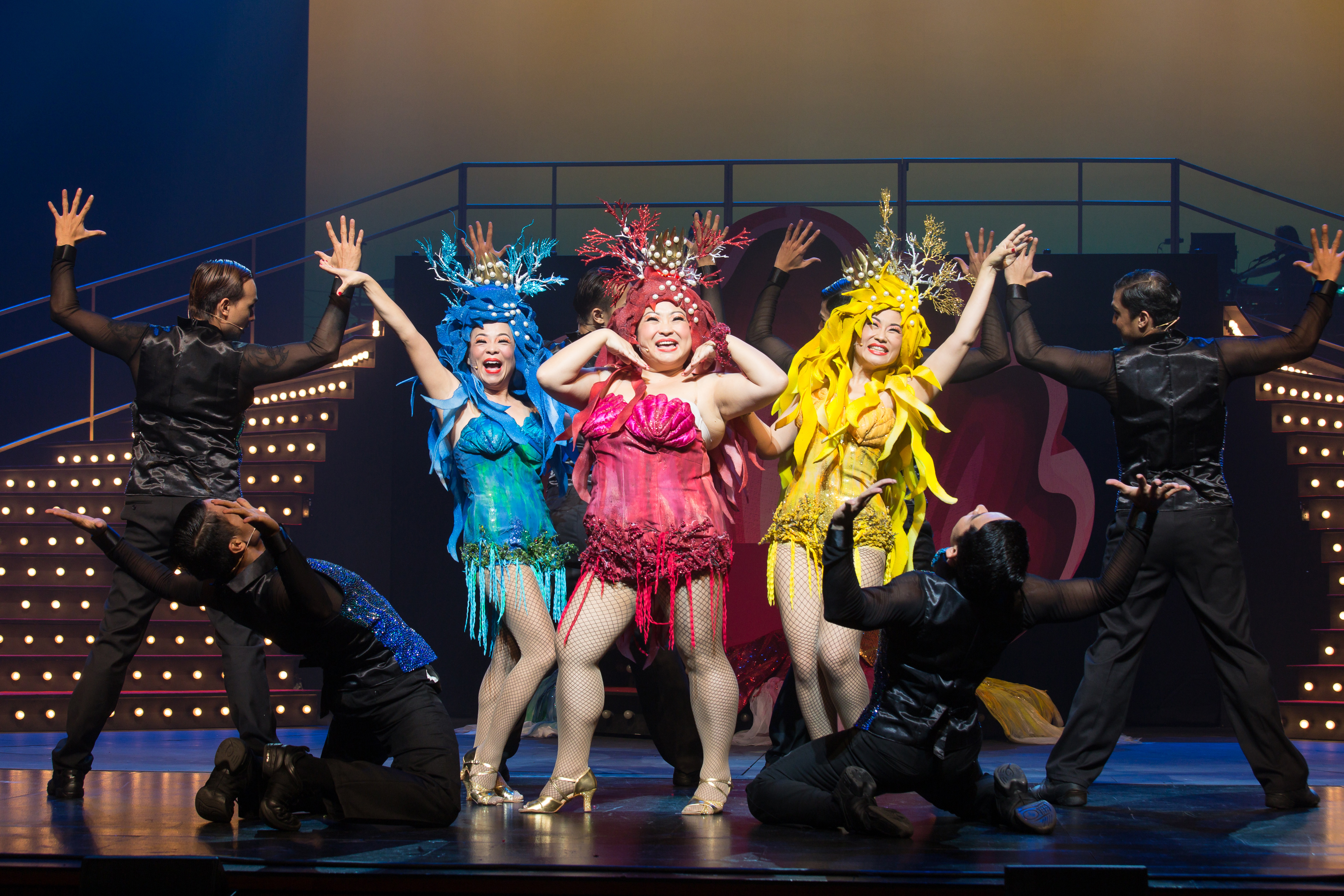
The History of Singapore Part 2, Dim Sum Dollies, Esplanade Theatre, 22 Dec 2014

The Dim Sum Dollies: Pam Oei, Selena Tan, Denise Tan
To cap off a delightful year in the audience, I caught the Dim Sum Dollies, with their new show The History of Singapore Part 2: The Growing Up Years. The Dim Sum Dollies are a trio that began doing locally-themed comedy musicals in 2002, and have become a regular fixture of popular culture here. I'd never seen them before, and was happily surprised to find that their audience had grown from the small Esplanade Recital Studio back in 2002, to weeks of sold out shows on the main stage.

As the title suggests, this is another autobiographical sketch of our sunny island set in the sea. They run through a quick montage of what apparently happened in Part 1 -- going from the first founding of this 'Singa Pura' (or 'Lion City') by one Sang Nila Utama in 1299, to British colonisation in 1819, World War II, and all the way to our independence in 1965. Part 2 thus starts with the Dim Sum Dollies fawning over the newly elected party, and progresses in high octane energy, colours, singing and dancing, towards our most recent public debates. 

Unfortunately, for a Singaporean, watching a show about Singapore, made by Singaporeans, I found the whole affair surprisingly inaccessible. I have to attribute it mostly to the fact that I simply didn't live through a lot of it. It would seem that many of the historical vignettes were written for an older crowd, who would get a lot of insider jokes that simply hadn't trickled down a generation. Sure, I know Changi airport opened in 1981, but no social studies text of mine really dwelled on the apparently disdainful reactions of neighbouring states at the time, which was what the humour decided to focus on. References to the many public mascots in the 70s and 80s espousing values such as productivity, cleanliness, personal savings, etc. were completely lost on me because most had disappeared from media by the time I was sentient. Hence I likewise spent that segment blinking in confusion as other members of the audience laughed heartily.

As history moved into more familiar territory however, I continued to find the references extremely random and obscure, and thus decided that much of the problem lay in the writing itself as well. Despite living through, and myself debating in class, about whether to open our first local casinos in the 2000s (for all the revenue but societal degeneration it might bring), I found the jokes to be simply un-amusing, and brought further down by meaningless song verses that sprang out of nowhere in vain attempts to rhyme.

If the random (or rather, chapalang) historical references weren't an obstacle enough, I ran up against a linguistic barrier as well. The Singlish spoken locally is an amazing mixture of just about every racial group's tongue -- primarily English, complemented with Mandarin, Malay, Tamil, Hokkien, etc. But while I speak it everyday, I unfortunately don't know enough of each language to catch the long phrases the Dollies would break into, and could see much of the audience leaning over to translate jokes to others as well.

The greatest barrier in understanding this piece however, was one of perspective. In such a short time, Singapore has done a profound number of things. Armed with heady ambition and a wicked efficiency, we've built things, built them again, spawned industries, risen ranks, about-faced from third world to first in under 50 years. The result: a country that has grown faster than our understanding of it. Thus, the narrative or perspective of public issues is so diverse such that when the Dollies talk of Lee Kuan Yew's successes, I truly don't know if they're being satirical or reverential. There are also so many different issues percolating, that when they talk about the protest at Hong Lim Park, I really don't know whether they're referring to the one about foreign talent, or government investment, or LGBT. 

But I digress -- this has now turned into a commentary on Singapore, rather than one on art. Yet, like every society before and after us, is art not the means by which we discover who we are?

Friday, December 12, 2014

Don Quixote, Singapore Dance Theatre, Esplanade, 6 Dec 2014

The Singapore Dance Theatre premiered Petipa's Don Quixote last weekend (between them and the Royal Ballet, this is an oddly fashionable Christmas choice this year!), adding their first new full length ballet in seven years. It was staged by ex Royal Ballet Principal Cynthia Harvey (whose dancing I've become quite fascinated with after a few short clips on Youtube), and Saturday's first cast had Rosa Park as Kitri, and Chen Peng as Basilio (pictured).

Funnily enough, this is only the second time I've seen the Singapore Dance Theatre in 9 years, despite it being the sole classical ballet company in Singapore. (In fact, the last full length ballet of theirs I saw was one I was actually in...!) The company changed quite drastically in the time that I was living overseas -- seeing a new artistic director, a new generation of dancers, and a renewed focus on local modern choreography. Lacking the familiar taste of the company which I in many ways grew up with, I came back and satiated my dance appetite with younger companies instead, but am now finding my way back to this old friend.

Unfortunately, I found the reunion sadly underwhelming. I'd never seen or read Don Quixote before, and suspect that a lot of the confusion I felt came rather from the inanity that is Don Q rather than the staging, which is a shame. The ballet appears to run two parallel narratives -- that of Don Q and his intrepid imagined adventures, and the simple story of village love between Kitri and Basilio. The piece tries hard to connect these disparate elements from the beginning by having a prologue scene where Kitri and Basilio somehow find their way into Don Q's sitting room, while pursuing Sancho Panza who is pursuing a chicken. Though the programme booklet took pains to spell this out, I simply could not understand what was happening on stage at all. The other attempt at intertwining the storylines, where Don Q takes Kitri to be Dulcinea, is equally incomprehensible.

I suppose all these are concerns I really should take up with Petipa. However given that they must make do with this odd backbone of a storyline, I feel like any company bold enough to tackle it must be adept enough to relay the story's subtleties, so as to prevent the whole piece from devolving into a random assemblage of variations. The dancers themselves must make the story and its undercurrent of humour come to life, but SDT unfortunately fell quite flat in this respect. Much of the corps looks nervous and self conscious on stage, and of the leads only Park and Akira Nakahama as Cupid seem to possess the requisite dynamism and lightheartedness of the piece, but it's not enough to carry the rest of the cast with them.

The company only really began to shine through in Act 2's dream, when all the theatricality had been stripped away. Much as I remember it to be, this is a beautiful and poised company, in that they specialise in the more pristine aspects of classicism. Saccharine sweet flower waltzes, doleful swans and willies, tend (or at least tended) to be much more their thing. The dryads therefore proved much more familiar and enchanting territory. Then in the tavern, the awkward characterisations and waning energy of the corps return, but it is thankfully saved by Park and Chen executing a tickling faked death.

Act 3 is then also rescued by Park and Chen's excellent wedding pas de deux. Both are technically on point but sadly the same cannot be said for most of the rest of the cast. Throughout the piece there were common trips and misplaced landings, and many even looked disinterested to be there. One of the few who actually possessed visible stage presence was the background but distinctively noticeable Stefaan Morrow, an apprentice with the company whom I look forward to seeing more of in future productions. Singapore's talented dancers have sadly been a rare breed, but this tide is hopefully about to turn, following the new options made available in arts educations and arts careers several years ago. The first wave of that initiative should be graduating now, and it will be very interesting to see the careers they pursue.

On the whole, I was perhaps too demanding of my evening and couldn't stomach Petipa's classical abstractions, especially after diving straight into it from MacMillan's realisms. All the same I do think it's a good idea for the company to keep its focus on modern choreographies, and wait for a stronger crop of dance actors before attempting the more intricate full length ballets in the future.

Thursday, October 30, 2014

FAR, Random Dance Company, Esplanade Theatre, 14 Oct 2014

Another illustrious choreographer brought in for this year's dans festival was none other than Wayne McGregor! McGregor's Random Dance Company made their Singapore premiere performing FAR, a piece about the Age of Enlightenment -- the scientific revolution that "emphasized reason and individualism rather than tradition".

McGregor's choreographic style is extremely unique, and very beautiful. Its hallmark is a melee of contorting limbs, with mighty extensions threading through one another to make each move look like a new bloom of the human body. Or rather, an inhuman body. This was Planet FAR; the Crazy Extensions Team; Yoga on Steroids; (Minimum Percentage Body Fat Pageant..) And it was wonderful to essentially see the choreography in 'true McGregor form'. What I've seen before was performed by the Royal Ballet, but here, with his own company that lives and breathes his choreography, it is perhaps a clearer glimpse into just how he likes his dance vocabulary articulated. 

While I find his style a delight to watch, I'd never thought twice about how much underlying meaning or message it could convey. His pieces I've thoroughly enjoyed (on DVD) are Chroma, Limen and Infra, but it had never occurred to me to think deeper about them. 

I was thus surprised that in FAR, I could enjoy not only his signature corporeal twists, but also an interesting symbolism in the 10 dancer's motions. The whole piece is parsed into several different segments, each of which experiments with different combinations of dancers and variations of the choreography which I can only describe as each having their own unique 'consistency'.

The most starkly different segment is the first, done in brown hues and flame; while the remaining (about 7 segments?) are white-lit by an impressive LED array. The differentiation is clearly meant to signify the before and after of the new Age. Within the Age then, McGregor experiments with different forms of human unity and separation. It reminded me most of atoms or molecules trying to bond and repel at the same time -- as if each segment was a new petri dish I was passing under a microscope. The movements are at first fairly disorderly, with no real discernible pattern. Then, when order first strikes, it is beautiful. There is repetition and symmetry against the LED background that turns into a regularly ticking counter, and this space of uniformity, speckled even with traditional ballet steps, is so rare here and in any other McGregor that it is arresting. (Interestingly, perhaps because this troupe is so rarely required to be in sync -- as in Petipa-quality corps in sync -- they are perhaps not as neat as they could have been to make the effect even more stark.)

Following this, the dancers try to form pairs, then trios, or more permutations of uniformity, but succeed and fail in turn as this Age experiments with the extent of its individualism. The movements also (furthering the Age of Enlightenment theme) find different types of reason to follow, where in one case the choreography changes to have a 'sticky' quality, with dancers' centre of gravity moving closer to the ground, and limbs peeling off the floor more consciously.

I need to also make special mention of one dancer who stood out markedly from the rest for me: Fukiko Takase. She caught my continued attention because her arms had such a unique quality I've almost never seen in any other modern dancer -- a control of them which perhaps surpassed that of her legs. In ballet class, I've always been told to 'resist' my leg as it comes in or extends, such as in a rond de jambe en l'air. But here was someone who did the exact same with her arms, and seemed to place them exactly and consciously in time and space, rather than carelessly or casually as counterweights to the rest of the body, as is typically the case. It seems a strange detail to focus on, and it took me a while to realize what was so different about her, but to me it enriched the choreography even more and perhaps gave McGregor much more limb to speak with. 

Here's to much more McGregor visiting our sunny island again!

Monday, October 13, 2014

Matthew Bourne's Swan Lake, Esplanade, 11 Oct 2014

It's time for the da:ns festival again in Singapore! They've consistently brought in stellar productions year on year (e.g. Sylvie Guillem, Paris Opera Ballet), and this time was no exception, with Matthew Bourne hitting the Singapore stage for the first time.

Bourne's Swan Lake is incredibly far from the original. I've only seen one other Bourne piece, Play Without Words, which struck me most for its layered complexity and depth. As such I was surprised at the amount of levity and humour in his Swan Lake, from the outright fumbling of the Girlfriend, to subtle eye-rolls of the dog walker. Yet, the piece is anything but superficial. While it may start with a good dose of slapstick humour, it follows the Prince to some dark places indeed in his battle against depression.

In fact, the piece was unexpectedly reminiscent of Mayerling. Much like Rudolph, this Prince lacks his mother's love, and tries to make up for it in similar ways such as wielding a gun and shooting an innocent bystander. The temptations of Odette and Odile are no longer about simple fairy-tale love, but are instead opposing sides of sanity. As Odette, the magnificent Jonathan Ollivier draws Siegfried away from suicide in a beautiful rendition of the white swan pas de deux. I had originally seen this in isolation as part of the recent Deloitte Ignite Moved By Myth (with Ed Watson as the Swan and Liam Mower as the Prince), and had mistaken it as straightforward homoeroticism. But rather than flirting with the Swan, I see the Prince is instead flirting with Reason.

Ollivier's Odile is even more alluring. He is steamy, sensual, and I love the cavalier way he enters the ball from the balcony. His wild, devilish seduction is the perfect counterpoint to the earnest Odette that eventually sacrifices himself for the Prince's eternal peace.

The best part about the piece for me was Bourne's fantastic use of the music. It's as if Tchaikovsky finally found what he was writing for, and you wonder what on earth Petipa was choreographing to all the while before. Bourne leverages the transitions in the music so appropriately, such that I can't imagine any other use of an upbeat segment in Act 2 but for a disco jive, and such that the stolen moments between Odile and the Prince at the ball truly feel like private segues Tchaikovsky wrote just for them.

Unfortunately however, the steps of the choreography just aren't my cup of tea. Despite how well thought out every detail is, the word "tawdry" kept coming to mind. I'm sure I'm just too uppity, or far too used to the classical Swan Lake, but I found the steps predictable, and oftentimes rather untidy. As good as the corps is, the costumes do them no justice as each white tassle shivers with every slight imbalance. Every head tick and arm flick is uncannily swan-like, yes, but I found an excess of it to cheapen the grandeur of the imposing corps. The couples' dancing in Act 3 was also too blandly lascivious, with hip gyrations so overused they came off hackneyed. I found that, as with Play Without Words, I much prefer the direction (if that's the right term) of the piece to his steps -- such as the emergence of the swans from under the Prince's bed, or the play with shadows and masks as the Queen and her lackeys visit the Prince in prison.

Thus on balance, it's back to Petipa for me. The audience loved it though, and the night ended in many curtain calls and ovations.

Wednesday, September 24, 2014

The Chorus; Oedipus, Victoria Theatre, 23 Aug 2014

In contrast to Facing Goya I'd seen the week before (yes -- a terribly delayed review), which required quite a bit of concerted attention and post-processing to properly appreciate, The Chorus; Oedipus was an immediate and effortless delight. It's directed by Jae-Hyung Seo, written by Areum Han, composed by Uzong Choe and choreographed by Eun-Jung Jang. It was first produced by the companies LG Arts Centre and Juk-Dal in 2011.

So here's how the show was mysteriously advertised: as a K-pop musical rendition of Greek tragedy. It inspired terribly little confidence, and I nearly foisted the tickets on someone else. But the rather off-the-mark marketing simply meant that the evening was able to completely blow my expectations out of the water.

The most immediately unique aspect of the show is that the whole thing is conducted on stage. The normal seats are left empty and the audience sits with the cast on the stage itself, at the centre of which is a circular 'arena' on which most of the action takes place. Four pianos nearby provide the accompaniment, and the chorus, when not acting, takes a corner of the stage. Seo's rationale is to harken the piece back to its original Greek theatre format, for the "audience to vividly witness the downfall of Oedipus as closely as the citizens of Thebes did". It is for this reason also that he has highlighted the choral element of Greek theatre, to bring it back to its roots.

The show starts with the folks of Thebes lamenting the drought, and Creon suggesting that avenging Laius' death is the answer to the nation's and Oedipus' woes. The audience is quickly enraptured from the way the citizens swivel their chairs around the circular stage, following Oedipus as he proclaims his resolve. One is viscerally swept up in everything he says as the chorus shifts around him, reflecting their engagement in his words.

Another striking scene is where Oedipus visits the oracle, who reveals the disturbing truth that he was Laius' murderer. The cast transforms into the birds whose prophecies the oracle interprets -- flapping haphazardly and ominously around her. With their hands reaching up into the sky, fingers pointed like beaks ready to strike, they caw sharply with their desperate message of doom.

Simply everything was phenomenal. The acting incomparable, the singing emotive, the choreography complete. It was by the latter that I was really most profoundly impressed -- every movement was heavily imbued with meaning. There is a quickening of the heartbeat in the frantic fights and chases, a real haunting fear as Laius stalks eyeless and desperate across the stage, and a depressing calm as the abandoned baby Oedipus lays silently quivering on the ground. Of note, both Laius and baby Oedipus were played by Sun Pyo Kim, whose expressions and vocalizations were daring and exactly on point for each character or creature he donned.

Subtleties such as these were just a sample of the attention to detail ubiquitous throughout the piece. Not a single stone was left unturned, with every second rich in meaning -- each twitch of the suspicious eye, wiggle of the judgmental finger, or angle at which they turned their bodies away from Oedipus' heinousness. One such moment that stayed with me was where two of the cast are fighting, and one is pushed into a piano. As he falls on it he plays a discordant chord, marking the moment in the score as well as in action. Also of note, even before the show started, there were various complaints about how hot the theatre was -- but ushers explained that the temperature was at the request of the director, who presumably used it as yet another means to embed the audience in Thebes.

At the final moment, the curtain of the stage is raised, and Oedipus walks away through the empty audience seats, having banished himself from Thebes. The aisles are dotted with sign posts and random seats are spotlit. The moment he leaves through the theatre entrance, thunder sounds -- rain has returned as the prophecy foretold. And the audience leapt to its feet.

Monday, September 15, 2014

Facing Goya, Victoria Theatre, 16 Aug 2014

As a fan of Michael Nyman's, I was eager to watch his opera Facing Goya, especially following the ovations it received at Spoleto a few months ago. I was also particularly intrigued to discover what a "science fiction opera" actually was. Debuting in 2000, with libretto by Victoria Hardie, and directed by Ong Keng Sen (a homegrown Singapore talent!), the opera explores the question of whether Francisco Goya's creativity might be recreated through science. The first half examines the validity of the prospect through 20th century craniometry; the second, through 21st century genetics. Thus the piece is a classic debate on Arts versus Science.

The choice of Goya as the piece's ambassador-for-the-Arts is driven by the legend that "Goya asked friends to remove his head prior to burial to prevent tomb thieves and early craniometrists from getting hold of his brain for research." Unfortunately for him, the Art Banker (played by Suzanna Guzman) has done just this, and despite her protestations, the skull lands in the hands of four craniometrists (Aundi Marie Moore, Thomas Michael Allen, Museop Kim and Anne-Carolyn Bird) who attempt to diagnose its features for the source of Goya's creativity. Two of them expound theories on how relative proportions, or the size of features, imply kindness or intelligence or so on, while two fiercely contest them.

I confess that most of the abstruse libretto truly escaped me, except for the repeated references to Goya's "snub nose" and the virtuous qualities it thus implied in him. Hardie certainly made an effort to weave in many founding craniometrists and their beliefs, but unless I read the libretto dedicatedly, the specific debate is lost. All that's left is a general impression that craniometry was a science which, though now proven preposterous, was a handy tool for bigotry in years past.

And it is on this point that the first half ends summarily. As it draws to its interval, references to Hitler and his own beliefs in anthropometry's truth (thus Aryan supremacy) gradually increase, culminating in a slide show depicting the horrors of World War II. The message is clear -- this is what reducing the quality of an individual to his appearance leads to.

In the second half, the craniometrists transform into geneticists, with the whacky antediluvian antics of yesteryear replaced by today's cutting edge science. They embark on largely the same format of debate (but with wings now, instead of craniometry instruments, because I suppose pipettes and agarose gel would have been odd props. Then what of the glittering skulls that appeared later...? Never mind.) The intrigue is that while this debate clearly leads down the same path as before, we are far more tempted to believe in today's predictive capacity of genetics. After all, they foretell disease, and does dealing with disease not affect the personality? And so go several other arguments, which, when pitched in a scientific lingo more familiar to us, become more convincing.

Thus the piece very effectively juxtaposes scientific perspectives of yore and today, to conclude (for me at least) that humans are essentially dumb idealists, ever searching for a way to classify and segment those around us. (I am intentionally excluding analysis of the far-too-perplexing segue where Goya reappears, in fully cloned form, and matador dress, to copulate with the Art Banker.) While the science-driven typecasting of craniometrists may sound ludicrous and racist, we're essentially quite poised to do the same thing with genetics, in the search of yet a better way to explain the human condition. It's that need that will ruin us, not the science.

Just as subjective as the art science debate is, so was the reception to the opera divided. The evening was speckled with sporadic applause, as if the audience were unsure when or even if to clap. No standing ovation the night I went; and spying during the interval and after the show revealed more confusion about the piece than anything else. A further foray into reviews finds them equally ambivalent -- a "claptrap", according to the New York Times, and attaining a "new level of resonance", according to the Financial Times.

Personal conclusion: I truly enjoyed the piece! It was definitely inaccessible at times, due to the libretto as mentioned (the first line is an unintelligible "Dogs drowning in sand"), odd plot points (Goya's revival), and inexplicable character choices (I'm not sure which side of the debate the Art Banker stood on by the end?). Even the music was occasionally cacophonous to me; its lack of obvious structure a jarring departure from MGV. All put together, it is indeed too slippery for the unaccustomed palette to grab hold of. But by the end, it met my standards for a unique and provocative work of art -- wherein it starts off as an apparent jumble of sights and sounds, but soon one can discover a theme, a pattern, very much of its own creation. I love a piece that can deliver its own voice and language like that, even if I've yet to make full sense of it. Coupled with the chance to dive into a philosophical reflection on science as a tool in the human search for meaning, I walked away officially provoked.

Wednesday, January 25, 2012

Wicked, Grand Theater Marina Bay Sands, 14 Jan 2012

Let me profess that Wicked is my most beloved musical ever. It's a wonderful portrait of the human spirit, and from that very first cut into intermission when Elphaba had completed her ascent and sung the last note of Defying Gravity, and I was sitting in the Gershwin Theatre blown away and with tears in my eyes -- ah, that's when I got irredeemably hooked.

I saw that first Wicked on Broadway in '06, saw the West End version in '08, and many repeats of the soundtrack later, I caught the Australian cast in their Singapore run a week ago. And delightfully true to form it was -- I could tell by the lump in my throat come intermission. The acting was on point, the music inspiring, and the whole ensemble infused with a wicked green energy.

This being my third viewing though, I couldn't get as much into the story as I had before, given that I knew everything that was coming. I don't know if that's a fault of my jadedness or of the cast's -- that there was nothing truly refreshing about the evening. Every joke was played out the same way I remembered, every line delivered exactly alike. Perhaps there simply isn't much leeway for interpretation in every iteration of Wicked, leaving merely a very entertaining sing-a-long session behind. (And that I did, to the chagrin of my neighbours.)

The only part which gave me renewed appreciation was the scene where Elphaba and Fiyero rescue the lion -- Jemma Rix truly gave quite a butterflies-in-stomach, 'hands touch, eyes meet' excitement of first love, which I don't remember to have moved me in Wickeds before. Susie Mathers as Glinda managed to squeeze some fresh laughs out of me as well during the ever-entertaining Popular.

In terms of singing, Mathers was spot on -- a delightfully slick soprano whose notes suitably glided and bounced over the accompaniment like bubbles. I found Rix to be quite disappointing though, simply because of her narrow range, meaning the parts of Defying Gravity that needed to pack a real punch were instead sung at almost a whisper. It wasn't harmful enough to threaten the emotion of the scene though. Apparently (I hadn't checked before, and now I have I wish I appreciated it more then...), the Elphaba I saw in London was none other than Kerry Ellis (and Eden Espinosa on Broadway) so I suppose my bar was set really high.

To nitpick the other actors: Bert Newton did not quite become the eccentric balloon-jetting Wizard I had in mind; Fiyero David Harris was not a good dancer and his singing merely passable; the rest of the main cast not particularly memorable. But as a group, their dancing and acting was filled with energy and pizzaz, turning Oz into a truly inviting and enrapturing place.

So on the whole, though in parts there was room for improvement, overall it truly was a Wicked as spectacular as any other (it seems Stephen Schwartz simply made an unassailable musical). I was transported right back into Broadway and for that I give this cast its chops. It was good enough that I've been chiming and whistling the soundtrack all week, and am plotting to go again.

Sunday, January 22, 2012

Paris Opera Ballet, Giselle, Esplanade Theatre, 21 Jan 2012

Tonight I caught Giselle, with the classic Paris Opera Ballet -- starring les étoiles Clairemarie Osta and Mathieu Ganio.

I must say I'm so pleased with the arts scene that's wafting into Singapore. I remember a little over a year ago I was in Europe clinging to my experiences of the Royal Ballet, Bolshoi, West End, etc., and I now find they have all delightfully followed me home. I've had such a fantastic helping of performing arts this year without having to go anywhere at all, and it makes me so very glad.

And tonight I got to see the best Corps de Ballet in memory. Their calibre of dancing was exquisite, and their coordination impeccable. I never knew a corps could add quite so much to a ballet, and I ended up looking forward to their scenes more than anything else. From the angles of their head to the exact elevation of each of their jetes to the placement of their arms, every single movement was perfectly synchronized. Their dancing was powerful and prominent, instead of forming the usual moving backdrop. Watching that segment where the willis hop their fondu arabesques across the stage was incredibly surreal -- I felt like I was staring into one of those infinitely reflecting mirrors.

In fact, I swear I (and the audience) cheered louder for them than for the stars. Honestly I found Osta and Ganio to be nothing special -- technically excellent, sure, but just a tad stiff. Which, actually, may just be carryover from days in a corps so perfected. (I do remember feeling the same lack of emotional turnover when I managed to catch La Dame Aux Camelias in Palais Garnier in '10.)

I will grant them that they didn't have all that much to play with in Giselle though. It really struck me today how 2-dimensional and somewhat.. soporific of a ballet Giselle is. Your standard peasant opening scene, followed by the fleeting conflict of Giselle's madness, and then the merrymaking of the undead. I was more than a little bored.

Thursday, December 8, 2011

Kevin Spacey, Richard III, Esplanade Theatre, 19 Nov 2011

Having just watched Horrible Bosses, it's a bit strange to now review Kevin Spacey's dramatic Shakespearan performance of Richard III. That character wasn't all too far removed from Richard though -- equal parts dirtbag and hilarity.

The production on the whole was a magnificent thrill. I'd say credit for the evening goes to Sam Mendes' direction. The piece was brought effectively into modern times -- the set, the costumes, the visual effects, the music, all helping to show the timelessness of Shakespeare's work. Having never read Richard III, I was surprised by how palatable the evening was to my sadly plebeian literacy. That said, I would have loved the chance to have read and studied it beforehand. (The evening suggested to me that Shakespeare is better served in a semester-long college course than a one night play, where you don't have the time to pick up all the delicious complexities lying behind the written word. Guess I'll just have to watch it several times over.)

The cast was generally brilliant. Their (and I suppose Mendes' as well) interpretations were rich and thoughtful -- transporting you to that secondary layer of the character despite not fully understanding the language. Some though, like Lady Anne, sadly portrayed the character the way I did in a prepubescent production of Romeo and Juliet -- lots of shouting and grand proclamations, in an excessive dramaticism indicative of no interpretation of the character whatsoever. Sorry, Lady Anne.

And to Spacey, the promotional highlight -- his Richard was full-bodied and complex, so much so that by the end I had sympathized with his insanity, and lamented his misunderstood life. He separated himself so effectively from his murders that I too, found him temptingly innocent. I most appreciated each tick Spacey embodied Richard with, each double take, each open and close of his body as he gained and lost confidence in turn.

My biggest delight with the show was probably in the music and set. The drums (comprising the entirety of the music) effectively bookended each scene with curt, suspenseful transitions. Aided by projections of the scene titles and the illusory clouds floating by, the effect was truly cinematographic. The stage, a simple white room, was surprisingly efficient, serving as both a cold tower of imprisonment and a warm family home. My favorite was when the up-stage end of the stage opened for the second half of the play, revealing walls cracked and gray, much like the added depravity of Richard's inner world come the latter acts.

Anyway at the end of it my only gripe was perhaps with the over-modernization of the text. Jokes were gleaned from the script which were only funny by a modern context, which made me wonder how fidelic one really has to be to the text when showcasing Shakespeare. Something I'll dwell on before my next Shakespearean play, which this one has nicely whetted my appetite for.

Steven Hough & Alexander Shelley, Liszt Legacy, Esplanade Concert Hall, 2 Dec 2011

On Friday evening, had the pleasure of watching Leeds Conductors Competition winner Alexander Shelley conduct the Singapore Symphony Orchestra in Liszt's Prometheus and Hamlet, Strauss' Don Juan, Op. 20, and last but not least, Rachmaninov's Piano Concerto no.3 played by Steven Hough.

The first half of the evening, comprising Prometheus, Don Juan and Hamlet, gave Shelley three diverse canvases on which to showcase his talents. All three were new pieces to me, and conducting is an art I'm similarly not all too familiar with -- the nuances each conductor imparts in a piece is something I haven't been able to tease out yet. All the same, I found Don Juan to be particularly riveting. The rise and fall of the music were truly emotive, every chapter of the story engagingly and suspensefully told. I suppose experience will be able to tell me where the paper composition ends, and the conductor's interpretation begins -- and for now my review is superficial.

Rach's Piano Concerto though is a piece I'm very familiar with -- definitely one of my favorites and the purpose of my visit that evening. Steven Hough is likewise one of my favorite pianists (immature though the list is as yet). I had the pleasure of seeing him once before, and found I had a penchant for his gentle keystrokes -- this way of hitting the keys that seems like he's more stroking a cat. And so I was hoping for him to bring a measured, pensive approach to Rach 3, but instead found his interpretation to be surprisingly rushed. Because of the speed, the notes seemed to carelessly tumble over one another, to the extent that the piano was at times out of sync with the orchestra, and really quite cacophonous. His playing was no doubt technically impeccable, but I found the musicality to be quite lacking. Perhaps it was where I was sitting, but the orchestration did not suit me well either -- much-loved intricacies of the background winds and strings were often lost to an overpowering piano.

Oh well. I think this one does come down to personal taste, and too much familiarity with the slower versions I usually hear. I have heard Rachmaninov preferred it to be fast, and will soon make my way to YouTube to listen to his original rendition again. But I can't help but wonder how the magnificent crescendo about 8 minutes into the first movement is meant to be anything but grandiose, careful, and generously epic -- instead of over too soon.

Sunday, October 16, 2011

Sylvie Guillem, 6000 Miles Away, Esplanade Da:ns Festival, Oct 15 2011

Had the great privilege of watching Sylvie Guillem for the first time ever last night, in her triple bill that premiered at Sadler's Wells July this year. 6000 Miles Away puts together a Forsythe premiere in Rearray for herself and Nicolas Le Riche; a 2002 Jiri Kylian piece 27'52" for Aurelie Kayla and Kenta Kojiri; and lastly a Mats Ek solo for Guillem in Bye.

So I've never personally been the largest Sylvie Guillem fan (partially because growing up as a young dancer and hearing her name, I thought she was equally legendary and equally retired as Anna Pavlova). Her style for some reason never resonated with me -- I know it sounds ridiculous but her mighty extensions have always sort of obstructed my view of the character underneath. That said I can sure well tell the difference between taste and talent though, and Ms Guillem is clearly one hell of a dancer.

And then, that being said, Rearray kind of bored me. I must confess I am a conservative traditionalist when it comes to music, I do need some rhythm to get into a piece, and couldn't fully appreciate the background of David Morrow's abstraction. The lights fade in and out as they dance about the stage, sometimes going so much as to cut off mid-stride and turn on again to find Le Riche still carrying on dancing. (And here's a nod to their skill for dancing in darkness.) The light play gives the piece an interesting episodic form, yet put-together, I'm not sure what the total message is. Not that there needs to be a message, but without it I was hoping for just a little more ingenuity with the steps... somewhat closer to what In the Middle, Somewhat Elevated would have offered.

27'52" was a slightly more palatable piece for me, and I am (as per viewing of Petite Mort on the venerable stage of YouTube) a fan of Jiri Kylian. I saw that same mixture of fluidity and frozen time in the piece, something which I suppose characterizes him. No clear narrative here either -- they dance, she removes her top, they continue to dance, and eventually are wrapped up in the stage's vinyl flooring. Sufficiently entertaining.

Bye was a totally different story though. It made my evening. There was clever play with cinematography, coupled with the narrative of a woman breaking out of her tepid, unnoticeable life to be a little wild and go a little crazy. The music -- complete with a little ragtime jive -- nicely affords this. It's almost a frantic desperation to explode, to express, to live, to ignite, within the brief space and time of uncensorship this woman affords herself. Guillem goes from standing on her head to executing a long, beautifully hyper-extended, gravity-defying grand jete, to nodding about rather ostrich-like. I found her to be fiercely intelligent during Wednesday's In Conversation interview, specific in her taste and insistent that a piece at its very least must change or provoke you, and this is the product.


ETA 22 Dec '11: Just received a Beethoven piano sonata CD and so incredibly delighted to find that the soundtrack to Bye was in fact Beethoven's Piano Sonata #32 in C minor. What an unbelievably eccentric piece. I have much to learn of Beethoven. I think now I have to give him lion's share of the credit instead of Mats Ek.